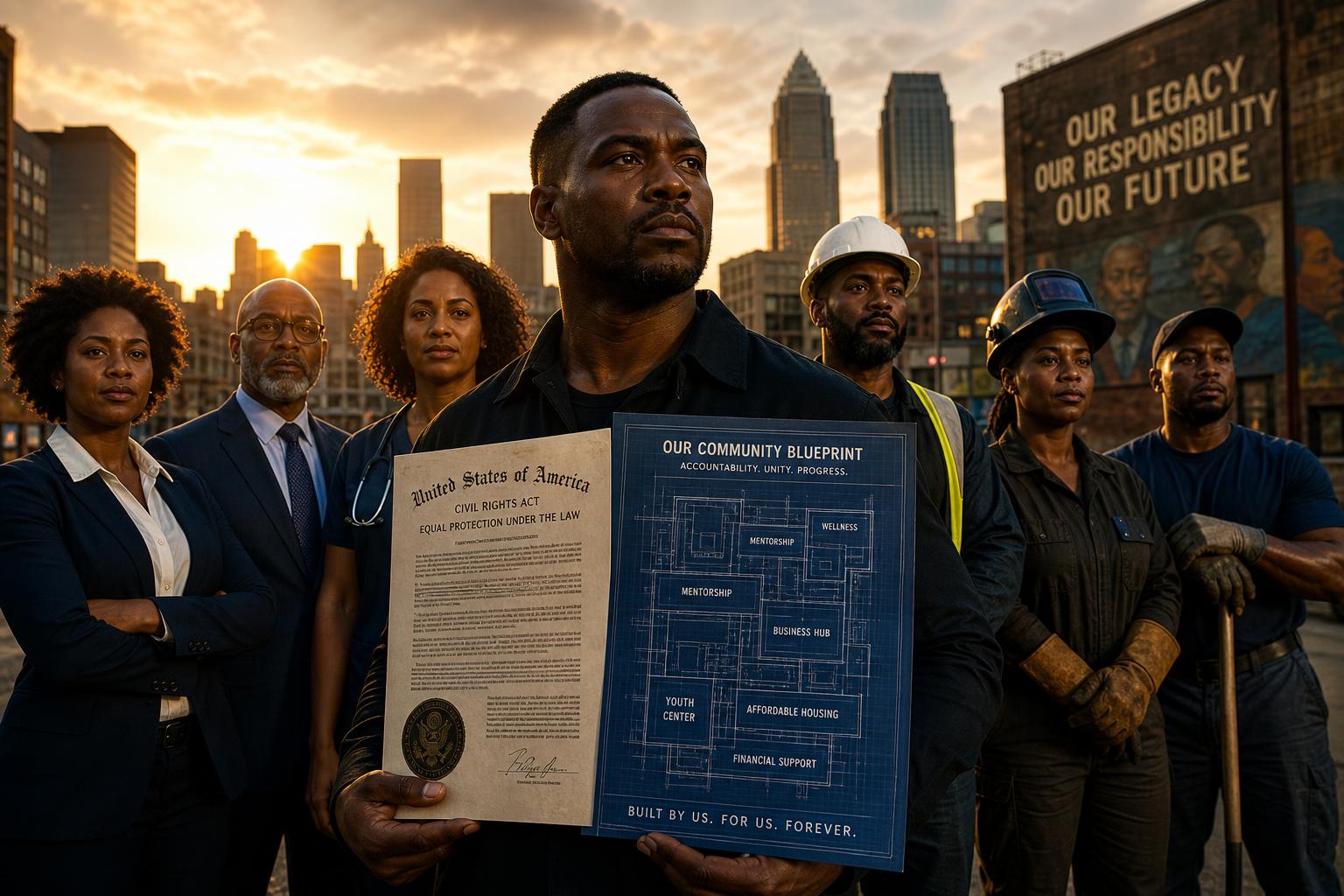
A debate has been moving through Black men's podcasts, barbershops, and group chats over the last several weeks. On one side, voices are calling for a Federal Anti-Black Hate Crime Bill — explicit legal protection against racially motivated violence targeting Black Americans. On the other side, voices are arguing that the more urgent crisis is the violence happening inside our own neighborhoods, between people who look like us, and that no federal bill will fix that. Both groups talk past each other. Both groups are partially right. And the framing itself is the problem.
Two things can be true at the same time. A Black person targeted because of their race deserves the full protection of the law. A Black family burying a child killed by another Black kid over nothing deserves an honest conversation about accountability. Neither truth cancels the other. Pretending we have to pick one is how serious people get pulled into unserious arguments.
The Leadership Mindset
Anyone who has run a company, led a unit, taught a classroom, or built a practice knows the rule: you do not get paid to describe the problem. You get paid to move the problem. Executives who only identify issues get replaced. Officers who only identify issues get reassigned. Entrepreneurs who only identify issues go out of business. The standard in every serious environment is the same — bring the issue, bring the context, bring at least the beginning of a path forward.
It is worth asking, plainly, whether the same standard applies to community leadership and public commentary. If a Foundational Black American executive cannot run a quarterly review by only listing complaints, why is that the accepted format for so much of our public discourse? The audience reading BlackCheck.info — business owners, veterans, professionals, educators, organizers — already operates under the solutions standard in their own lives. There is no reason to lower it when the subject turns to the community.
Protecting Black Americans From Racially Motivated Violence
The argument for a Federal Anti-Black Hate Crime Bill is not complicated. Equal protection under the law means equal protection in practice, not just in principle. When a person is attacked, harassed, run off the road, shot at, or killed specifically because they are Black, that is a category of harm with its own history in this country and its own pattern of being under-prosecuted. Federal language that names the harm clearly, sets sentencing standards, and gives the Department of Justice clear jurisdiction is a reasonable legislative ask. It is the same logic that produced earlier hate-crime statutes covering other protected categories.
Supporting that bill does not require anyone to ignore crime that happens inside our communities. It does not require pretending every interracial incident is racially motivated. It does not require hating anyone. It requires what any other constituency requires of its government: that the law treat harm against you with the same seriousness it treats harm against others.
Holding Ourselves Accountable
At the same time, the numbers inside our own neighborhoods are not a talking point invented by people who dislike us. They are mothers, fathers, grandparents, and children we know by name. Violence between Black Americans takes more of our young people every year than any external threat. Schools that do not function, fathers who are not present, mentorship pipelines that have collapsed, and economic deserts that strangle ambition all compound the problem. Naming this is not anti-Black. Refusing to name it is.
Accountability is not the opposite of protection. It is what protection is for. We do not advocate for safer streets so that we can avoid responsibility on those streets. We advocate for safer streets so that the children walking them have a fair shot at the lives their ancestors paid for in advance.
Where Are the Solutions?
A solution-oriented conversation in 2026 sounds different from a grievance-only conversation in 1996. It is specific. It is measurable. It is fundable. A short list of categories already producing results in Foundational Black American communities, when the work is taken seriously:
- Mentorship programs that pair boys and young men with working professionals — not as a one-time photo op, but as a multi-year relationship with check-ins, accountability, and exposure to industries they would not otherwise see. Working examples include 100 Black Men of America (national, headquartered in Atlanta), The Brotherhood/Sister Sol in New York, and Concrete Safaris' youth leadership pipelines in Harlem.
- Fatherhood initiatives that support men who want to show up for their children, including legal aid for custody, parenting classes that treat fathers as competent adults, and employment pipelines that make providing possible. See Real Dads Network in Detroit, Fathers' Uplift in Boston, and the National Fatherhood Initiative's 24:7 Dad curriculum now run inside dozens of Black-led community centers.
- Trade and vocational training in electrical, HVAC, welding, commercial driving, and the building trades — fields with immediate income, ownership pathways, and shortages that will not close in our lifetimes. HBCU Apprenticeship Network, Project HOOD's Leadership and Economic Opportunity Center on Chicago's South Side, and Baltimore's Civic Works Center for Sustainable Careers are placing FBA workers into union-scale jobs right now.
- Entrepreneurship education that goes past the inspirational and into the operational: licensing, accounting, contracts, procurement, and how to actually bid on a city or federal job. Russell Innovation Center for Entrepreneurs (RICE) in Atlanta, Black Ambition, and the Greenwood Initiative's Black-Owned Business Resource Center in Tulsa are concrete models.
- Community investment — pooled capital, real-estate cooperatives, and small-business funds owned and governed locally, rather than waiting on outside institutions to decide we are worth underwriting. OneUnited Bank, Hope Credit Union across the Deep South, and Atlanta's Greenwood Bank are FBA-led capital institutions; the Boston Ujima Project is the clearest working model of a democratically governed neighborhood investment fund.
- Conflict-resolution programs in schools and neighborhoods that interrupt disputes before they escalate, including credible-messenger work led by people the community actually listens to. Cure Violence Global (originating in Chicago), Advance Peace in Richmond and Sacramento, and Cities United have documented double-digit reductions in homicides where they are fully funded.
- Youth employment through summer jobs, paid internships, and apprenticeships that put money, structure, and adult relationships into a teenager's week. Chicago's One Summer Chicago, Boston's SuccessLink, and Urban Alliance (DC, Baltimore, Chicago, Detroit) have peer-reviewed evidence of lowering arrests and raising graduation rates.
- Financial literacy taught early and taught honestly — credit, taxes, insurance, investing, and the difference between looking wealthy and being wealthy. Operation HOPE (Atlanta, national footprint), The Gathering Spot's member education programming, and Earn Your Leisure's Invest Fest are scaling this work to audiences that traditional financial education never reached.
None of this is theoretical. Every organization named above is operating in 2026, with budgets, staff, and measurable outcomes. The question is not whether the work can be done. The question is whether we will fund it, scale it, and demand outcomes from it the same way we would demand outcomes from any other investment.
What Foundational Black Americans Have Already Built
It is easy, in a discourse dominated by crisis, to forget that Foundational Black Americans built schools, churches, banks, insurance companies, hospitals, fraternal orders, newspapers, colleges, and entire business districts during periods when the federal government was openly hostile to our existence. Tulsa's Greenwood, Durham's Hayti, Chicago's Bronzeville, Atlanta's Sweet Auburn — these were not accidents. They were the product of disciplined people who organized capital, educated their own children, and built institutions because no one else was going to.
That tradition is not a museum exhibit. It is an instruction manual. The same discipline that produced Black Wall Street is the discipline that produces a credit union, a charter school, a contractor's association, or a youth program today. The conditions are different. The method is not.
Both, Not Either
The trap of "either-or" thinking is that it lets everyone off the hook. If the only problem is racism, then nothing inside the community needs to change. If the only problem is internal, then the country owes us nothing. Both framings are convenient. Neither is true.
We can demand a Federal Anti-Black Hate Crime Bill and demand more from ourselves in the same breath. We can call out a racist attack on a Black family in one paragraph and call out a senseless killing in our own zip code in the next. We can hold the country to its promises and hold each other to our standards. These positions do not contradict. They reinforce each other. A community that protects itself internally has more moral authority — not less — when it asks the law to protect it externally.
The Standard Going Forward
Foundational Black Americans are not a constituency that needs to be rescued. We are a people with a track record. The future will not be determined by who can describe the problem with the most eloquence on a podcast. It will be determined by who builds the program, writes the check, takes the meeting, opens the business, mentors the kid, runs for the seat, files the bill, and shows up next week to do it again.
Two things can be true. We can demand protection from anti-Black racism. We can demand accountability inside our own communities. And the people best positioned to do both — at the same time, without apology, and without contradiction — are already reading this. The only question left is what we build next.
Share this article
Editorial standards: BlackCheck distinguishes verified facts, attributed claims, and open questions. Corrections are appended publicly to each piece.