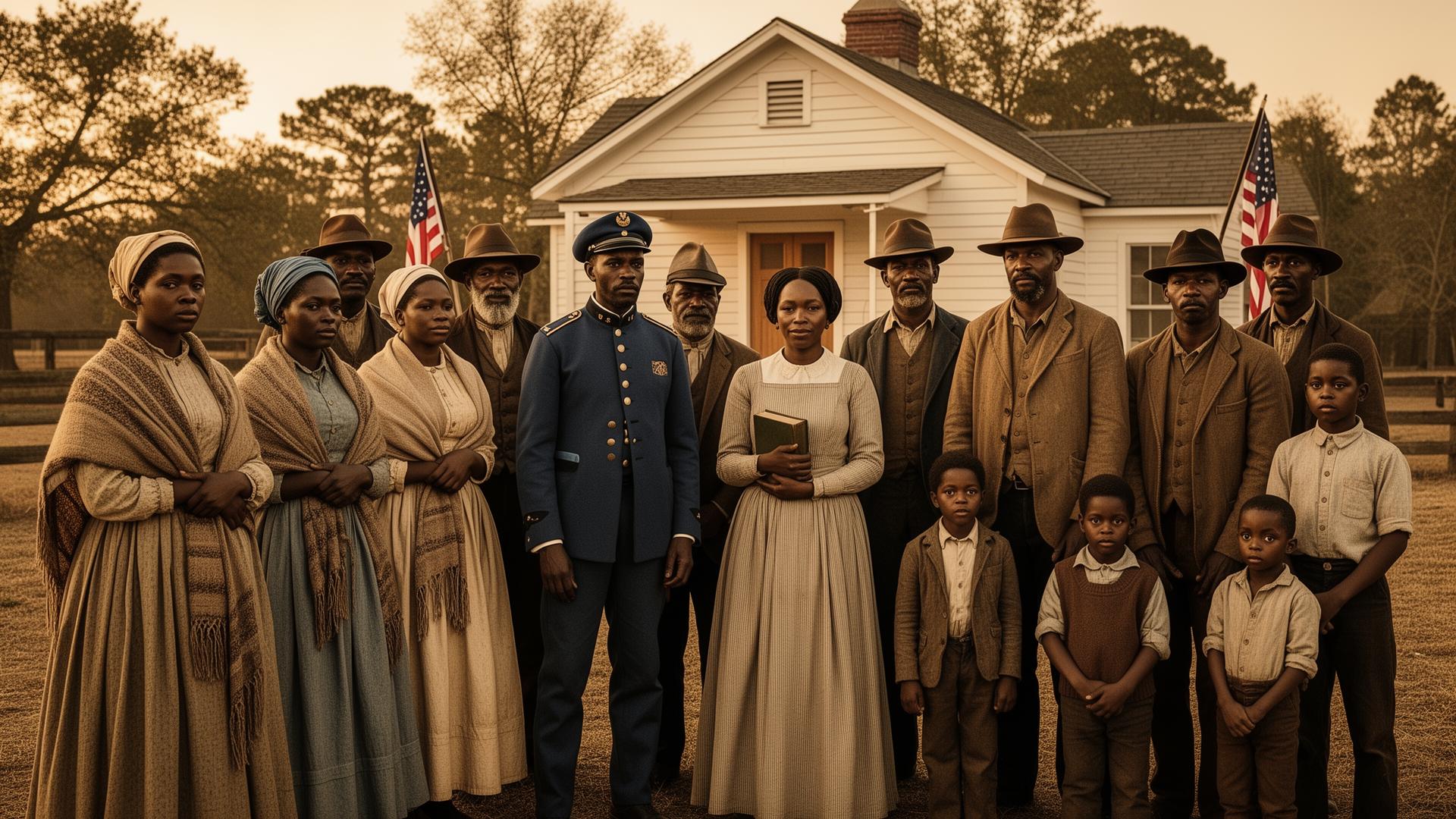
For a brief window after the Civil War, the United States attempted something it had never tried before: to extend full citizenship, the ballot, and federal protection to four million people who had been legally classified as property only years earlier. The era we now call Reconstruction (1865–1877) produced extraordinary gains for newly freed Black Americans — and was met with an equally extraordinary backlash that dismantled most of those gains within a generation. Understanding what was built, and how it was undone, is essential to understanding nearly every chapter of Black American history that followed.
- 1865 — Civil War ends; 13th Amendment ratified; Freedmen's Bureau established.
- 1866 — Civil Rights Act of 1866; Memphis and New Orleans massacres.
- 1868 — 14th Amendment ratified (citizenship, equal protection).
- 1870 — 15th Amendment ratified (Black male suffrage); first Black member of Congress, Hiram Revels (R-MS), seated.
- 1870–71 — Enforcement Acts and Ku Klux Klan Act passed.
- 1875 — Civil Rights Act of 1875 bars discrimination in public accommodations.
- 1877 — Compromise of 1877; federal troops withdrawn from the South.
- 1883 — Supreme Court strikes down the Civil Rights Act of 1875.
- 1896 — Plessy v. Ferguson sanctions "separate but equal."
1. The End of Slavery and a New Beginning
The surrender at Appomattox Court House in April 1865 ended four years of war, but it did not, by itself, end slavery. Emancipation came in stages: the Emancipation Proclamation of 1863 had freed enslaved people in Confederate-held territory; the 13th Amendment, ratified in December 1865, abolished chattel slavery throughout the United States "except as a punishment for crime whereof the party shall have been duly convicted." That exception would later be exploited through convict leasing, but in the moment, the amendment marked a constitutional break with two and a half centuries of legalized bondage.
Roughly four million formerly enslaved people entered freedom with almost nothing — no land, no capital, limited literacy by force of law, and, in many cases, separated from family members sold during slavery. Yet the historical record is clear that Freedmen did not enter freedom passive or unprepared. Within weeks of emancipation, formerly enslaved people were registering marriages, searching newspaper notices for lost relatives, founding churches and schools, and pressing federal officials for land and protection.
"Slavery is not abolished until the black man has the ballot."
2. The Reconstruction Era (1865–1877)
Reconstruction had three overlapping aims: to restore the seceded states to the Union on terms acceptable to Congress, to define and protect the civil and political rights of freed people, and to physically and economically rebuild a devastated South. These goals produced sharp conflict between President Andrew Johnson, who favored a lenient approach to former Confederates, and the Radical Republicans in Congress, who insisted on federal enforcement of Black citizenship.
The Freedmen's Bureau, formally the Bureau of Refugees, Freedmen, and Abandoned Lands, was established in March 1865 under the War Department. Between 1865 and 1872 it negotiated labor contracts, adjudicated disputes, distributed food and medical aid, helped reunite families separated by sale, and — most enduringly — built or supported more than 4,000 schools attended by an estimated 250,000 students. The Bureau also issued the marriage certificates that today form the backbone of much African American genealogical research.
Land was the unresolved question. General William T. Sherman's Special Field Order No. 15 (January 1865) set aside coastal land in South Carolina, Georgia, and Florida for Black families in 40-acre allotments — the origin of the phrase "forty acres and a mule." President Johnson rescinded the order later that year and returned most of the land to former Confederate owners, foreclosing what historians widely regard as the most significant missed opportunity of the era.
3. Black Progress During Reconstruction
Despite the loss of the land question, the documented achievements of Freedmen during Reconstruction were remarkable by any historical measure.
Political participation
With the protection of the 14th Amendment (1868) and the 15th Amendment (1870), Black men registered to vote in unprecedented numbers across the South. By 1867, an estimated 80 percent of eligible Black men were registered in the former Confederate states. Between 1870 and 1877, roughly 2,000 Black men held public office, including 16 members of the U.S. Congress, hundreds of state legislators, and local officeholders ranging from sheriffs to school commissioners. Hiram Revels of Mississippi became the first Black U.S. senator in 1870; Blanche K. Bruce, also of Mississippi, became the first to serve a full Senate term. P.B.S. Pinchback served briefly as governor of Louisiana in 1872–73 — the only Black governor of a U.S. state until the late twentieth century.
Education
The hunger for literacy among newly freed people is one of the most thoroughly documented facts of the era. By 1870, more than 4,000 schools served Black students across the South, staffed by a mix of Black teachers, Northern missionaries, and Freedmen's Bureau agents. Many of today's Historically Black Colleges and Universities trace their founding to this period, including Fisk University (1866), Howard University (1867), Morehouse College (1867), Hampton Institute (1868), and Tougaloo College (1869). Black literacy rates rose from an estimated 10 percent in 1865 to roughly 30 percent by 1880 and continued climbing through the turn of the century.
Economic life
Black Americans entered trades, opened small businesses, and built independent farms where they could acquire land. The Freedman's Savings and Trust Company, chartered by Congress in 1865, attracted deposits from tens of thousands of Black savers before mismanagement and the Panic of 1873 caused its collapse — a financial blow whose effects on Black wealth accumulation historians still study. Even so, by 1900 Black Americans owned roughly 15 million acres of farmland, a peak figure that would erode substantially over the twentieth century.
Community institutions
Independent Black churches — the African Methodist Episcopal Church, the AME Zion Church, and the National Baptist Convention chief among them — grew rapidly and became the organizing infrastructure for education, mutual aid, and political life. Black newspapers, fraternal orders, and benevolent societies multiplied. These institutions, more than any single law, are what carried Reconstruction-era gains forward into the Jim Crow century.
- 4 million — formerly enslaved people freed by 1865.
- ~2,000 — Black officeholders during Reconstruction.
- 16 — Black members of the U.S. Congress, 1870–1877.
- 4,000+ — schools for freed people built or supported by the Freedmen's Bureau.
- 15 million — acres of farmland owned by Black Americans by 1910 (peak).
4. The Backlash Against Reconstruction
Opposition to Reconstruction was organized, armed, and political. The Ku Klux Klan, founded in Tennessee in 1865–66, spread across the South as a paramilitary arm of conservative white Democratic politics, targeting Black voters, officeholders, teachers, and any white allies. Later organizations — the White League in Louisiana (founded 1874) and the Red Shirtsin Mississippi and the Carolinas (1875) — operated more openly, suppressing Black turnout through assassination, mass violence, and public intimidation campaigns.
Specific incidents document the scale. The 1866 Memphis and New Orleans massacres killed dozens of Black residents and helped persuade Congress to pass the Reconstruction Acts of 1867. The Colfax massacre in Louisiana on Easter Sunday 1873 left an estimated 60 to 150 Black militia members and freedmen dead. The 1874 Battle of Liberty Place in New Orleans saw the White League briefly seize the state government. The Hamburg massacre in South Carolina (1876) and the Wilmington coup in North Carolina (1898) bookended a long campaign of organized political violence.
Congress responded with the Enforcement Acts of 1870 and 1871, including the Ku Klux Klan Act, which empowered the federal government to prosecute conspiracies to deprive citizens of constitutional rights. Under President Ulysses S. Grant, federal prosecutions temporarily suppressed Klan activity, particularly in South Carolina. But enforcement required sustained political will, and that will began to erode as Northern public opinion turned toward sectional reconciliation.
5. The End of Reconstruction
The disputed presidential election of 1876 produced the Compromise of 1877: Republican Rutherford B. Hayes was awarded the presidency in exchange for, among other concessions, the withdrawal of remaining federal troops from the last Reconstruction-era state governments in Louisiana and South Carolina. With federal enforcement gone, the surviving Republican state governments collapsed, and "Redeemer" Democratic administrations took power across the South.
Reconstruction did not end on a single date. Federal commitment had been declining for years — through the Panic of 1873, the Supreme Court's narrow reading of the 14th Amendment in the Slaughter-House Cases (1873), and the Court's gutting of federal civil rights prosecutions in United States v. Cruikshank (1876), which arose from the Colfax massacre. The 1877 troop withdrawal was the formal end of an experiment that had been weakening for half a decade.
6. How Reconstruction Was Reversed
The dismantling of Reconstruction was carried out through law as much as through violence. Black Codes, first enacted in 1865–66 and revived in modified forms after 1877, restricted Black labor mobility, criminalized vagrancy, and channeled Black workers back into plantation labor under contract. By the 1890s, Southern states had built a legal architecture of disfranchisement and segregation that historians now group under the name Jim Crow.
The instruments were specific and well-documented:
- Poll taxes required payment to vote, often retroactively over multiple years.
- Literacy tests were administered selectively by local registrars, with white applicants typically exempted.
- Grandfather clauses waived these requirements for anyone whose ancestor had voted before 1867 — by design, excluding virtually all Black voters.
- White primaries limited Democratic Party nominations, which were tantamount to election in the one-party South, to white voters.
- Convict leasing exploited the 13th Amendment's criminal-punishment exception, leasing primarily Black prisoners to private companies under conditions historians describe as worse than slavery in some respects.
- Segregation statutes separated schools, transit, housing, hospitals, cemeteries, and public accommodations, ratified by the Supreme Court in Plessy v. Ferguson (1896).
The effect was systemic. In Louisiana, Black voter registration fell from roughly 130,000 in 1896 to about 1,300 by 1904 — a 99 percent decline within eight years of the state's new constitution. Similar collapses occurred across the South. Rights nominally guaranteed by the 14th and 15th Amendments became, in practice, unenforceable for most of the next seventy years.
7. The Long-Term Consequences
The reversal of Reconstruction had compounding effects. The wealth gap that opens in the post-Reconstruction decades — through land loss, exclusion from credit, denial of New Deal benefits, redlining, and discriminatory implementation of the GI Bill — is the gap that researchers at the Federal Reserve, the Brookings Institution, and the Joint Center for Political and Economic Studies continue to measure today. Black landownership, which peaked at about 15 million acres around 1910, fell below 3 million acres by the end of the twentieth century.
Political representation collapsed and did not recover until the passage of the Voting Rights Act of 1965 — nearly ninety years after Reconstruction ended. Educational segregation, formalized by Plessy, persisted until Brown v. Board of Education(1954), and in practice well beyond. The Black Codes' criminal-justice legacy is traceable through convict leasing, chain gangs, and modern debates over mass incarceration.
Historians continue to debate Reconstruction's legacy. The earlier Dunning School, which dominated academic history through the mid-twentieth century, portrayed Reconstruction as a corrupt failure — a view since refuted by the work of W. E. B. Du Bois (Black Reconstruction in America, 1935), Eric Foner (Reconstruction: America's Unfinished Revolution, 1988), and a generation of historians working with primary sources from Freedmen, Black legislators, and the Bureau's own archives.
8. The Legacy of Reconstruction Today
Reconstruction's questions remain open questions in American public life. Who counts as a citizen, and what does citizenship guarantee in practice? What is the federal government's role in protecting voting rights against state-level interference? How should the nation reckon, if at all, with the economic consequences of slavery and its post-Reconstruction reversal? Debates over voter identification, school funding, fair housing, criminal justice reform, and reparations all trace back, in part, to questions Congress and the Supreme Court first answered — and then unanswered — between 1865 and 1896.
The 14th Amendment remains the constitutional foundation of nearly every modern civil rights ruling. The institutions Freedmen built — the HBCUs, the Black church bodies, the mutual aid traditions — remain pillars of Black American civic life. The genealogical records produced by the Freedmen's Bureau and the Freedman's Savings Bank are the starting point for most Black Americans tracing family history across the 1870 census wall.
Conclusion
Reconstruction was, simultaneously, one of the most ambitious democratic projects in American history and one of its most thoroughly reversed. In a span of twelve years, formerly enslaved people built schools, won elections, served in Congress, founded universities, and pressed the federal government to enforce a new definition of citizenship. In the decades that followed, organized violence, Supreme Court decisions, and state-level legal architecture rolled back most of those formal gains.
Both halves of that story are documented in the historical record. Treating Reconstruction only as a failure obscures what Freedmen actually accomplished; treating it only as a triumph obscures the scale of what was taken back. The fuller account — what was built, what was destroyed, and what survived — is what the rest of Black American history has been working with ever since.
Selected sources and further reading: Eric Foner, Reconstruction: America's Unfinished Revolution, 1863–1877(1988); W. E. B. Du Bois, Black Reconstruction in America(1935); Henry Louis Gates Jr., Stony the Road (2019); records of the Bureau of Refugees, Freedmen, and Abandoned Lands (National Archives, Record Group 105); the Freedman's Bank Records (NARA); Congressional records of the 41st–44th Congresses; Slaughter-House Cases (1873); United States v. Cruikshank(1876); Plessy v. Ferguson (1896); Brown v. Board of Education (1954); Voting Rights Act of 1965.
Share this article
Editorial standards: BlackCheck distinguishes verified facts, attributed claims, and open questions. Corrections are appended publicly to each piece.