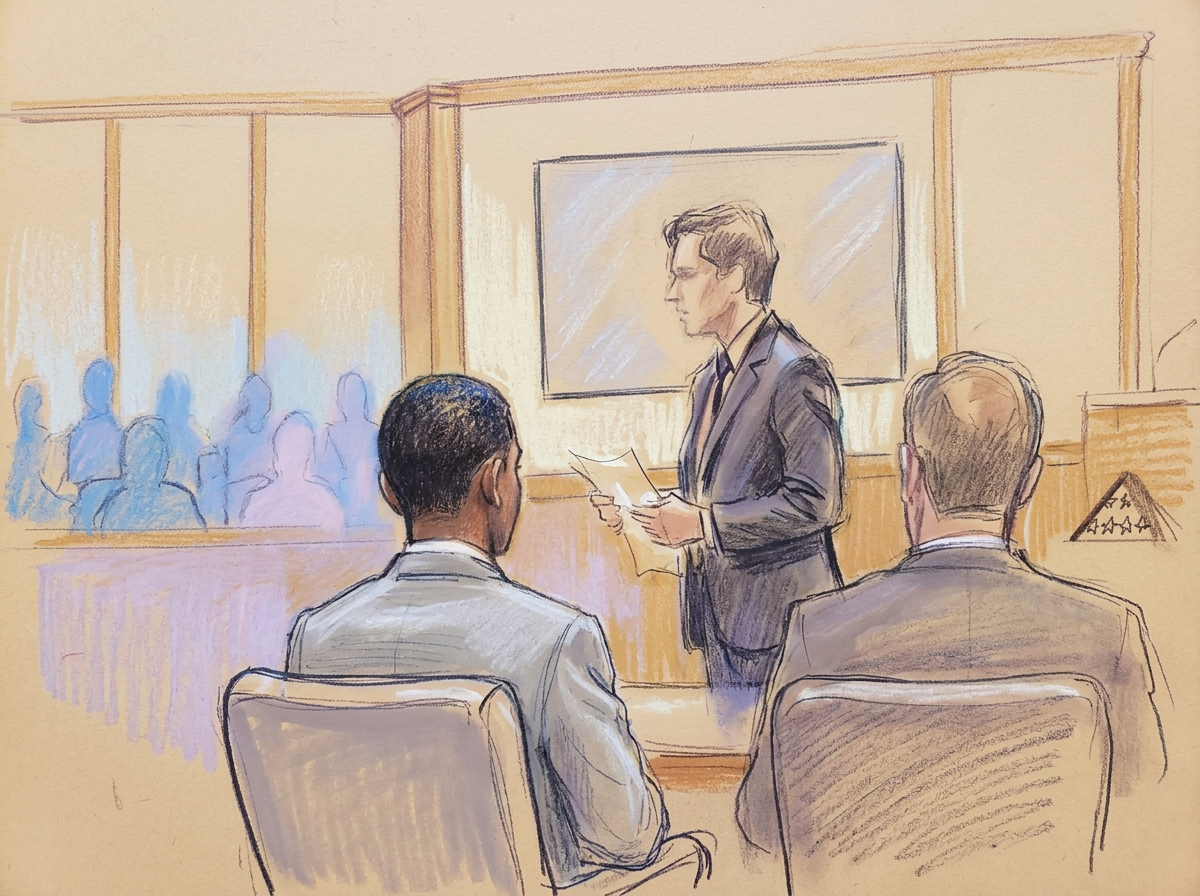
The case of Karmelo Anthony — a Texas teenager charged in the fatal stabbing of 17-year-old Austin Metcalf at a high school track meet in April 2025 — has generated sustained national attention, competing fundraising campaigns, and an unusually polarized public debate. The recently concluded proceedings have not settled the underlying questions so much as sharpened them. This analysis is not an attempt to relitigate the verdict. It is an attempt to ask, honestly, what the public record actually establishes, what it does not, and why so many readers across the political and racial spectrum continue to feel that something about the case remains unresolved.
1. The Case, As the Record Describes It
On April 2, 2025, students from Frisco Memorial High School and Frisco Centennial High School were gathered at Kuykendall Stadium in Frisco, Texas for a district track meet. According to the arrest affidavit filed by the Frisco Police Department, a verbal confrontation broke out under a team tent over seating. The affidavit states that the confrontation escalated into a physical altercation in which Austin Metcalf was stabbed once in the chest with a knife. He was pronounced dead at a nearby hospital.
Karmelo Anthony, then 17, was detained at the scene. According to the same affidavit, he acknowledged the stabbing to officers and made statements indicating he believed he was acting in self-defense. He was charged with first-degree murder and held initially on a $1 million bond, later reduced by a Collin County judge. The case proceeded in adult court under Texas law because of his age at the time of the alleged offense.
The intervening months produced a parallel set of public events: large online fundraisers organized on behalf of both families, competing press conferences, the temporary relocation of the Anthony family after reported threats, and a steady stream of social-media commentary, much of it operating well ahead of any evidence formally introduced at trial. The trial itself moved forward in 2026, concluding with the verdict that has prompted the current debate. (Readers seeking the day-to-day procedural history should consult primary court filings in Collin County and contemporaneous reporting from local outlets including The Dallas Morning News, KERA News, and national wire coverage.)
2. The Video Evidence Question
From the earliest hours after the stabbing, the existence — or non-existence — of video footage has been one of the most litigated questions in the court of public opinion. Multiple witnesses were present. Phones were out. Stadium and school district cameras were reportedly in operation. Yet the public has not, as of this writing, seen a single continuous, authenticated recording of the moments immediately preceding the stabbing.
What has been publicly described, primarily through court testimony and statements from attorneys on both sides, are fragments: an argument under a tent, words exchanged, a request or demand to move, a movement toward the defendant, and the single fatal motion. The descriptions, depending on which side is offering them, emphasize different details — who stepped forward first, what tone was used, whether the knife was visible before contact, how much time elapsed between the verbal exchange and the strike.
That gap between what witnesses say happened and what the public can independently verify matters. There are legitimate reasons evidence is not always released: protective orders, juvenile considerations where applicable, the integrity of jury deliberations, and the privacy of minors who appear incidentally in footage. There are also reasons that withheld evidence corrodes confidence — particularly in cases where the racial dynamics of the parties involved are already part of the public conversation. Both can be true at once.
What can be said responsibly is this: the absence of a publicly available, end-to-end recording means that members of the public forming opinions are, by definition, doing so on partial information. That includes commentators who insist the video would exonerate Mr. Anthony, and commentators who insist it would condemn him. Neither claim, in the absence of the footage, is verifiable.
3. Aggressive Approach vs. Legal Justification
One of the most discussed legal questions in the case is the distance between an aggressive approach and a legally justified use of deadly force. They are not the same thing, and Texas law — like the law of most states — does not treat them as such.
Texas Penal Code §9.31 permits the use of non-deadly force when a person reasonably believes it is immediately necessary to protect against another's use or attempted use of unlawful force. Section §9.32 permits the use of deadly force only when, in addition, the actor reasonably believes deadly force is immediately necessary to protect against the other's use or attempted use of unlawful deadly force, or to prevent the imminent commission of certain enumerated felonies. The "stand your ground" provisions in Texas remove a duty to retreat in places a person has a legal right to be, but they do not lower the threshold for what counts as a reasonable belief of imminent deadly threat.
In practice, that gives juries a difficult, fact-bound question. Being approached aggressively — raised voice, closed distance, pointed finger — is not, on its own, a use of deadly force. But context matters: relative size, prior threats, the presence of weapons, the speed of escalation, and what a "reasonable person in the actor's situation" would have perceived. Reasonable jurors can, and often do, weigh those factors differently. The verdict in this case reflects the jury's resolution of those factors on the evidence formally admitted at trial — not necessarily on the evidence the public has seen or imagines exists.
That distinction is uncomfortable but important. The legal question "Was this self-defense under Texas law?" is narrower than the moral question "Was this avoidable?" and narrower still than the cultural question "Would this have ended the same way with different people involved?" A verdict answers the first. It does not, and cannot, answer the others.
4. The Race Question — Asked Honestly
A great deal of the public conversation has centered on a counterfactual: if the races of the two teenagers had been reversed, would the charging decision, bond amount, media framing, fundraising response, or verdict have looked the same? It is a question worth taking seriously, precisely because it is being asked in good faith by people across the political spectrum, including those who reach opposite conclusions.
The honest answer is that no one can know with certainty. Each criminal case is decided on its own facts, before a particular judge, by a particular jury, in a particular jurisdiction. But honest uncertainty is not the same as having nothing to say. Decades of academic research — from the Sentencing Project, the U.S. Sentencing Commission's own reports, and peer-reviewed criminology literature — have documented disparities in how self-defense claims, bond amounts, and homicide charges have historically been resolved across racial lines. That body of evidence does not predict the outcome of any individual case. It does explain why the public reaches for the comparison.
At the same time, invoking those patterns to declare any single verdict racially motivated, in either direction, runs ahead of the evidence. Juries deliberate in private. Charging decisions involve dozens of variables. The same disparities that exist in the aggregate can be absent from a particular courtroom, and the reverse is also true. The most defensible posture for readers is to hold both ideas at once: the historical pattern is real, and the conclusion in any single case requires its own evidence.
5. Why the Public Wants More Transparency
The persistent demand — from commentators of every background — for more transparency in this case is not, in the editorial view of this publication, unreasonable. Public confidence in criminal verdicts is built less by the verdict itself than by the public's ability to see how it was reached. When the underlying evidence is sealed, redacted, or simply never released, the vacuum is filled by speculation, partisan framing, and viral video clips of disputed provenance.
There are real, lawful reasons evidence is not always disclosed: the protection of minors, ongoing appellate proceedings, witness safety, and the integrity of any future retrial. None of those reasons disappear because the public is impatient. But prosecutors, defense counsel, and courts also operate within an institution whose legitimacy depends, in the long run, on being seen as fair. Where transparency is legally possible — through unsealed exhibits, post-trial briefings, or the eventual release of body-worn camera and stadium footage — it tends to strengthen confidence in the result, including among those who disagree with it.
6. The Broader Questions
Whatever a reader concludes about the verdict itself, the case has surfaced a set of larger questions that will outlast the news cycle:
- Self-defense law. How should statutes written for adults apply to teenagers in fast-moving schoolyard confrontations?
- Juvenile justice. Under what circumstances should 17-year-olds be tried as adults, and how should the law account for adolescent development?
- Public trust in verdicts. What level of transparency is owed to a public that did not sit in the jury box but is being asked to accept the outcome?
- Media narratives. How do early framings — from local outlets, partisan commentators, and influencers — shape the public's perception of facts that have not yet been tested in court?
- Social media and evidence. What is the responsibility of platforms and users when fragments of video, real or fabricated, circulate as if they were the whole story?
- Race and the criminal justice system. How should the public hold two truths at once — that aggregate disparities are real, and that individual cases must be judged on their own evidence?
7. A Closing Note to the Reader
BlackCheck.info has taken no position on the guilt or innocence of Karmelo Anthony, the moral character of Austin Metcalf, or the motivations of the jury that returned the verdict. We have tried, instead, to lay out what the public record actually supports, where the gaps are, and which questions remain open for honest disagreement.
A family has buried a child. Another family has watched their child stand trial as an adult. A jury has rendered a decision under oath. None of those facts cancel each other out. Readers who want to think clearly about this case — and about the next one, and the one after that — are better served by holding the uncertainty honestly than by collapsing it into a slogan. Due process is a discipline. So is journalism. So, ultimately, is citizenship.
Sources and further reading: Frisco Police Department arrest affidavit (April 2025); Collin County District Court filings, State of Texas v. Anthony; Texas Penal Code §§9.31–9.32; contemporaneous reporting from The Dallas Morning News, KERA News, The Associated Press, and Reuters; U.S. Sentencing Commission, Demographic Differences in Federal Sentencing (most recent edition); The Sentencing Project, Report on Racial Disparities in the United States Criminal Justice System.
Editorial standards: This article distinguishes verified facts, attributed claims, and open questions. Where a claim is contested, both characterizations are presented. Corrections will be appended publicly at the bottom of the page.
Share this article
Editorial standards: BlackCheck distinguishes verified facts, attributed claims, and open questions. Corrections are appended publicly to each piece.