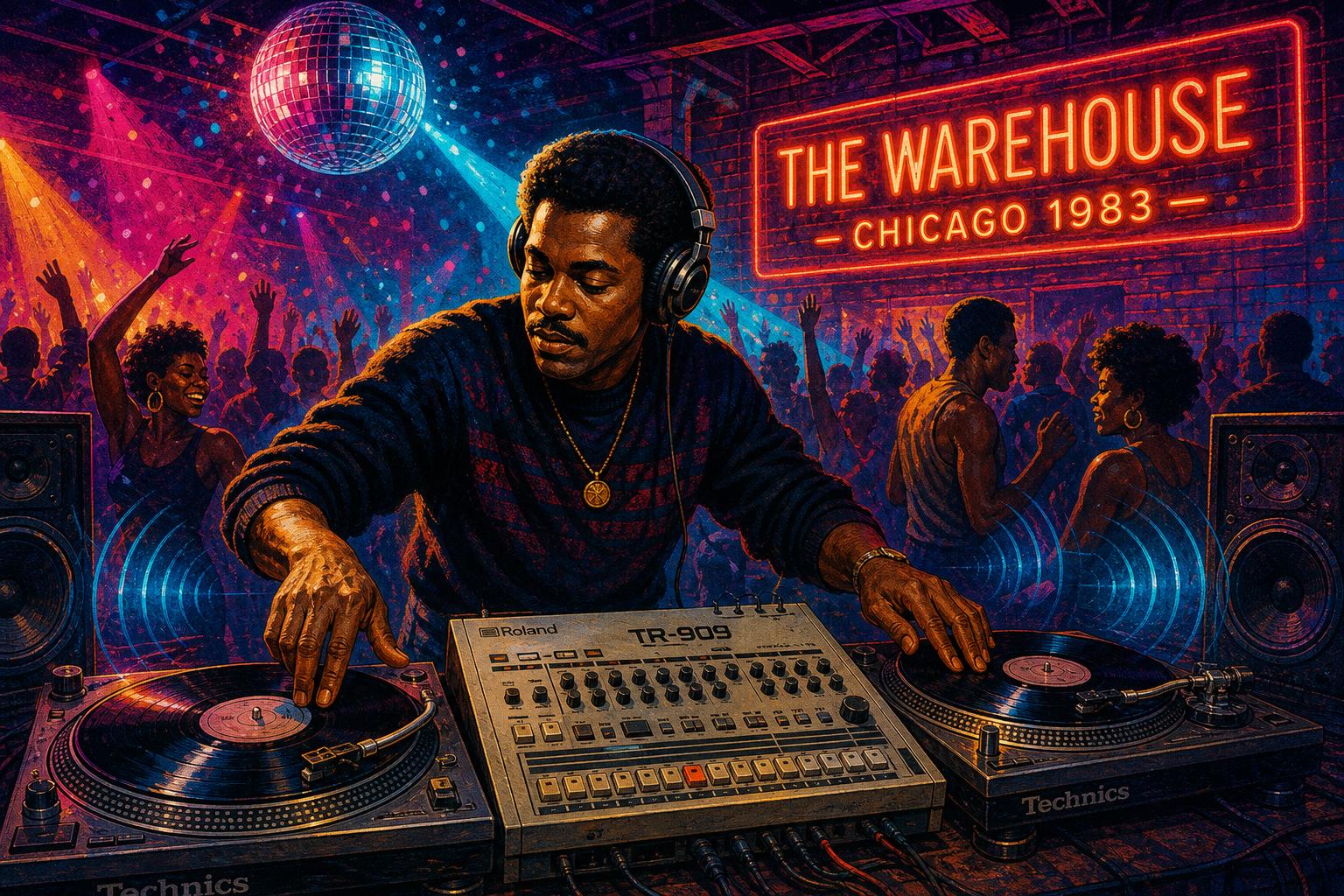
Some musical revolutions announce themselves with a stadium tour and a magazine cover. House music announced itself with a 4/4 kick drum, a rented warehouse on Chicago's West Side, and a roomful of Black, Latino, and queer dancers who had nowhere else to go. Forty years later, the sound those dancers helped invent is the rhythmic foundation of nearly every major dance festival on the planet — and one of the most globally influential Black American cultural exports of the late twentieth century.
- 1977 — Frankie Knuckles begins DJing at The Warehouse in Chicago.
- 1981 — Ron Hardy takes the residency at the Music Box; competing scenes accelerate the sound.
- 1984 — Jesse Saunders releases "On and On," widely cited as the first commercially pressed house record.
- 1985 — Trax Records and DJ International launch in Chicago, putting house on vinyl for the world.
- 1986 — Marshall Jefferson records "Move Your Body (The House Music Anthem)"; Mr. Fingers' "Can You Feel It" defines deep house.
- 1987 — Steve "Silk" Hurley's "Jack Your Body" hits No. 1 on the UK Singles Chart — house's first global pop breakthrough.
- 1988 — The UK's Second Summer of Love; acid house powers the British rave explosion.
- 2004 — Mayor Richard M. Daley proclaims August 10 "Frankie Knuckles Day" in Chicago.
- 2022 — Beyoncé's Renaissance returns mainstream attention to house's Black queer origins.
1. The Birth of House Music
Chicago in the late 1970s was a segregated, industrial city losing manufacturing jobs and gaining a generation of young people looking for somewhere to dance. Disco — itself a Black, Latino, and queer invention — had just been publicly humiliated at Comiskey Park's 1979 "Disco Demolition Night," an event widely understood, then and now, as a backlash with racial and homophobic undertones. The commercial radio rejection of disco did not kill the dance floor. It pushed it underground, into Black-owned and Black-run spaces where DJs were free to keep building on the music.
The Warehouse, a members-only club at 206 South Jefferson Street, opened in 1977 with a young Bronx-born DJ named Frankie Knuckles in the booth. The crowd was predominantly Black, gay, and devoted. Knuckles extended and edited disco, soul, Philly International cuts, and European electronic records into seamless, hours-long sets, layering drum machines under the vocals to keep the energy moving. Local record-store clerks began labeling import bins "as heard at the Warehouse" — soon shortened, by customers asking for "that house music," to a name for the entire sound.
2. The Founding Pioneers
House music is not the work of one person. It is the work of a documented, named community of Black American DJs, producers, and vocalists working in close conversation across a handful of city blocks.
- Frankie Knuckles (1955–2014) — "The Godfather of House." His Warehouse residency gave the genre its name and its template. Later productions including "Your Love" (with Jamie Principle) and "The Whistle Song" became global standards. In 1997 he received the inaugural Grammy for Remixer of the Year.
- Ron Hardy (1958–1992) — Resident at the Music Box from 1983. Where Knuckles was smooth, Hardy was raw and rhythmically extreme, pitching records up, playing edits backward, and pushing the dance floor harder. His sets are still studied by producers worldwide.
- Jesse Saunders — Released "On and On" in 1984 on his own Jes Say label, widely cited as the first commercially pressed house record and proof that the sound could exist on vinyl, not just on the night.
- Marshall Jefferson — Wrote and produced "Move Your Body (The House Music Anthem)" in 1986, the track that gave the genre an actual mission statement and a piano line that has been quoted across forty years of dance music.
- Larry Heard (Mr. Fingers) — Released "Can You Feel It" and "Mystery of Love" in 1985–86, inventing what would come to be called deep house: warmer chords, longer structures, more emotional weight.
- Farley "Jackmaster" Funk — Mixshow DJ on WBMX radio's Hot Mix 5, whose broadcasts carried the new sound out of the clubs and into bedrooms and car stereos across the Midwest.
- Chip E., Steve "Silk" Hurley, Adonis, Robert Owens, Lil Louis, DJ Pierre, Spanky and Herb J. (Phuture) — The extended first generation. Phuture's "Acid Tracks" (1987) accidentally invented acid house when they discovered what the Roland TB-303 bass synthesizer did when you turned the knobs.
"House music is a feeling. You can't really describe it. You have to feel it."
3. The Musical DNA of House Music
House sounds new because it is. It also sounds familiar because it is built almost entirely from earlier Black American musical traditions. The four-on-the-floor kick comes out of disco, which came out of funk and Philly soul. The vocal phrasing — call and response, declarative testimony, repeated hooks that build like a sermon — comes directly out of the Black church. The chord changes on records like "Promised Land," "Someday," and "Tears" are gospel progressions played on a synthesizer. The improvisational logic of a long DJ set — building tension, releasing it, calling the room to its feet — is the same logic that drives a jazz solo or a blues shout chorus.
What was new was the technology and the assembly. Drum machines (the Roland TR-808 and TR-909), affordable samplers, and basement four-track recorders let Black producers without access to major studios make full records at home. House is, in that sense, a direct descendant of hip hop's bedroom-production revolution happening in parallel in the South Bronx — two Black American genres invented within ten years of each other by people locked out of the formal music industry, using the cheapest equipment available.
4. House Music Leaves Chicago
By 1985, Chicago labels Trax Records (founded by Larry Sherman) and DJ International (founded by Rocky Jones) were pressing house records in volume. New York's Paradise Garage scene, led by DJ Larry Levan, was developing a parallel sound rooted in many of the same disco records — what would later be retroactively called "garage house." Eighty miles north of Detroit, three Black high school friends — Juan Atkins, Derrick May, and Kevin Saunderson, the Belleville Three — were inventing Detroit techno, a colder, more futurist cousin of house drawing on Kraftwerk, Parliament, and the same drum machines.
The breakthrough came overseas. In January 1987, Steve "Silk" Hurley's "Jack Your Body" hit No. 1 on the UK Singles Chart — the first house record to top a national pop chart anywhere. By 1988, British DJs returning from Ibiza had brought house and acid house home, fueling the Second Summer of Love and the UK rave explosion. From there the sound moved to mainland Europe (especially Germany, the Netherlands, and Italy), to South Africa (where it would later mutate into kwaito, gqom, and amapiano), to Brazil, to Japan, and onward.
5. The Evolution Into EDM
Every major branch of what is now marketed as Electronic Dance Music traces back to Chicago house, Detroit techno, or New York garage — and in most cases all three. Deep housefrom Larry Heard. Acid house from Phuture. Hip house from Tyree Cooper and Fast Eddie. Garage from Larry Levan and Tony Humphries. Tech house, progressive house, tribal house, French touch, big-room, future house — each is a regional or stylistic adaptation of the same Chicago-born template: four-on- the-floor kick, syncopated hi-hats, sampled or sung vocals, and the DJ as architect of the night.
The 2000s commercial EDM boom — Tiësto, Calvin Harris, David Guetta, the rise of Las Vegas residencies and Tomorrowland-scale festivals — was the mass-market commercialization of musical decisions made by Black DJs in Chicago basements twenty-five years earlier. That commercial scale is one of the genre's success stories; it is also where its origin story most often gets erased.
6. Global Influence
Electronic dance music is now one of the largest music economies in the world. The annual International Music Summit Business Report has consistently valued the global electronic music industry at between $6 billion and $11 billion across the past decade. Major festivals — Tomorrowland in Belgium, Ultra in Miami, EDC in Las Vegas, Awakenings in the Netherlands, DGTL in Amsterdam and São Paulo — draw hundreds of thousands of attendees each year. Spotify's "House" and related dance playlists are followed by tens of millions of listeners.
Outside the festival circuit, the influence is even broader. South Africa's amapiano, currently one of the most commercially explosive sounds on the African continent, is a direct descendant of house's deep-house and kwaito branches. Nigerian afrobeats producers routinely interpolate house tempos and structures. UK garage and its child genres — 2-step, grime, UK drill — all sit on rhythmic foundations that begin in Chicago.
7. Why the Origins Matter
Crediting the originators is not a debate about who is allowed to enjoy the music. House was built, from night one, for everybody on the floor. Crediting the originators is a debate about historical accuracy. When the standard story of "EDM" begins in the 2000s with a few European headliners, an entire generation of Black American innovators — many of whom did not become wealthy from their contributions and several of whom died young — gets erased from a story they wrote.
Chicago has taken some institutional steps. Mayor Richard M. Daley declared August 10, 2004 "Frankie Knuckles Day" after Senator (then State Senator) Barack Obama co-sponsored a resolution. A section of Jefferson Street near the original Warehouse site is now Frankie Knuckles Way. The Chicago House Music Festival, held annually since 2010 in Millennium Park, is a free city event explicitly programmed around the genre's Black founders.
8. The Continuing Legacy
House is not nostalgia. The genre's contemporary roster is deep and Black. Honey Dijon — a Black trans DJ and producer from Chicago — has become one of the most in-demand figures in global dance music, with production credits on Beyoncé's Renaissance and Madonna projects. The Black Madonna / The Blessed Madonna(Marea Stamper) has helped lead the contemporary house revival across Europe and the United States. Channel Tres, Kaytranada, DJ Lag, Black Coffee, Moodymann, and Theo Parrish are among the producers extending the sound into new territory while keeping its lineage visible.
Beyoncé's 2022 album Renaissance, built explicitly around house, ballroom, and disco, gave the genre's Black queer origins its biggest commercial spotlight in decades. The album's liner notes and credits read as an intentional act of historical bookkeeping — naming the pioneers, sampling their records, and thanking the scene that built the foundation.
Conclusion
House music began as the after-hours soundtrack of a community that mainstream radio had thrown away. Within a decade it had a UK No. 1, a global vocabulary, and the technical and cultural template for nearly every form of dance music that would follow. Within four decades it had become a multibillion-dollar global industry whose biggest festivals draw hundreds of thousands of people who, in many cases, do not know they are dancing to a Black American invention.
Knowing the story does not diminish the music. It deepens it. Every drop at a festival main stage, every late-night Berlin warehouse set, every amapiano hit out of Johannesburg, every Beyoncé four-on-the-floor cut is, in some measurable way, still playing the record Frankie Knuckles cued up at the Warehouse in 1977. That is one of the great cultural success stories of the modern era — and it began on Black American dance floors.
Selected listening: Frankie Knuckles, "Your Love" (1987); Mr. Fingers, "Can You Feel It" (1986); Marshall Jefferson, "Move Your Body" (1986); Phuture, "Acid Tracks" (1987); Steve "Silk" Hurley, "Jack Your Body" (1986); Robert Owens & Frankie Knuckles, "Tears" (1989); Larry Heard, "The Sun Can't Compare" (2005); Honey Dijon, Black Girl Magic (2022); Beyoncé, Renaissance (2022).
Selected sources and further reading: Jesse Saunders with James Cummins, House Music: The Real Story(2007); Tim Lawrence, Love Saves the Day: A History of American Dance Music Culture, 1970–1979 (2003); Simon Reynolds, Energy Flash: A Journey Through Rave Music and Dance Culture (1998); Micah Salkind, Do You Remember House? Chicago Queer of Color Undergrounds (2018); Frankie Knuckles oral history, Red Bull Music Academy (2011); International Music Summit Business Report, annual editions; Pump Up the Volume: A History of House (Channel 4 documentary, 2001).
Share this article
Editorial standards: BlackCheck distinguishes verified facts, attributed claims, and open questions. Corrections are appended publicly to each piece.