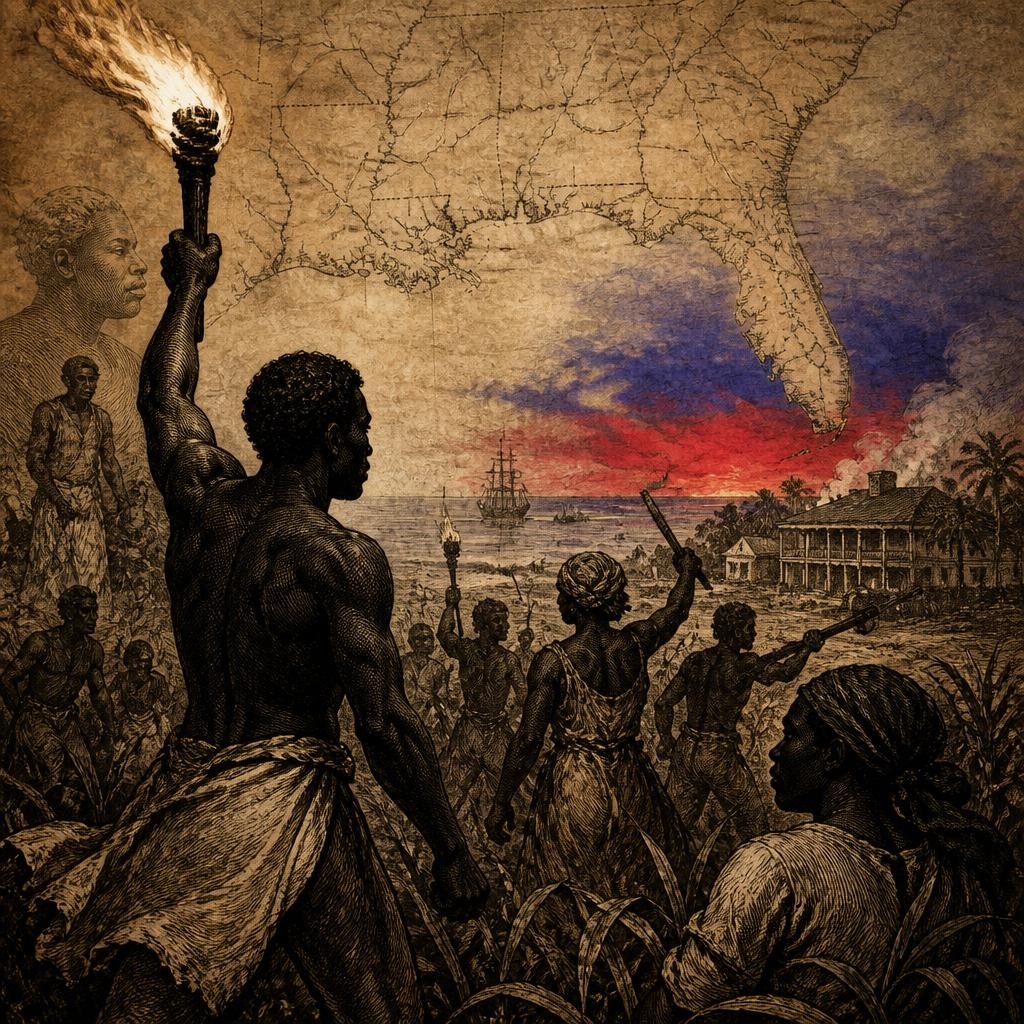
A claim circulates widely on social media: that the only reason Black Americans ever gained their freedom was the Haitian Revolution. It is repeated confidently, often as a rebuke, and it collapses more than three centuries of Foundational Black American resistance into a single foreign event. This piece is not a rebuttal to Haiti. It is a correction of the record — offered with full respect for one of the greatest freedom struggles in world history.
Beginning With Respect
The Haitian Revolution (1791–1804) is one of the most consequential uprisings in human history. Enslaved Africans in Saint-Domingue defeated the armies of France, Britain, and Spain, abolished slavery by force of arms, and founded the first Black republic in the modern world. That achievement deserves permanent reverence. It inspired enslaved and free Black people across the Atlantic World, terrified every slaveholding regime in the hemisphere, and forced European powers to reconsider the economics and politics of chattel slavery.
Nothing in what follows diminishes that. The purpose here is not to rank revolutions or measure suffering. It is to restore historical context that is often missing from online debates — context that matters because Foundational Black Americans have their own long, documented, and unfinished freedom struggle, and that struggle did not begin in 1791.
Black Resistance in North America Began in the 1500s
The record of African resistance on the North American mainland begins nearly three centuries before the Haitian Revolution. Africans brought to what is now the United States rebelled, escaped, sabotaged, litigated, and built free communities from the earliest days of European colonization.
San Miguel de Gualdape, 1526
In 1526, Spanish colonizer Lucas Vázquez de Ayllón established San Miguel de Gualdape, believed to be located along the coast of present-day Georgia or the Carolinas. It was the first European settlement in what would become the continental United States — and it was destroyed in part by an uprising of enslaved Africans, who revolted, fled the settlement, and are believed by many historians to have joined nearby Indigenous communities. This is widely recognized as the first recorded slave revolt in what became the United States. It occurred 265 years before the Haitian Revolution began.
Maroons and Black Soldiers in Spanish Florida
Throughout the 1600s and 1700s, self-emancipated Africans escaped English colonies and fled south to Spanish Florida, where the Spanish Crown offered freedom in exchange for military service and Catholic conversion. In 1738, the Spanish governor established Gracia Real de Santa Teresa de Mose (Fort Mose) near St. Augustine — the first legally sanctioned free Black settlement in what is now the United States. Its Black militia fought alongside Spanish forces against English incursions, most notably at the Battle of Bloody Mose in 1740. Maroon communities also formed in the Great Dismal Swamp of Virginia and North Carolina, sustaining generations of self-freed Africans well before Toussaint Louverture was born.
The 1712 New York Slave Revolt
In April 1712, a group of enslaved Africans in New York City set fire to a building and attacked the colonists who came to extinguish it, killing nine and wounding others. The colonial authorities responded with mass executions and torture. It was one of the earliest organized armed uprisings in the northern colonies — 79 years before Haiti.
The 1739 Stono Rebellion
On September 9, 1739, roughly twenty enslaved Africans — many of them veterans of the Kingdom of Kongo's civil wars, trained in European military tactics — gathered near the Stono River in South Carolina, seized weapons from a store, and marched toward Spanish Florida under a banner reading "Liberty." Their numbers grew to as many as one hundred before the colonial militia intercepted them. Stono was one of the largest slave rebellions in Britain's mainland North American colonies and led directly to the Negro Act of 1740, which restricted the movement, assembly, education, and manumission of enslaved people across the Carolinas. It happened more than half a century before news from Saint-Domingue reached American shores.
The Broader Pattern
These are the named events. Behind them are thousands of unnamed acts:
- 1687 Newton Plantation Revolt — St. Croix (then the Danish West Indies), crushed after several months.
- 1730s Virginia conspiracies — Several planned uprisings discovered before they could be carried out.
- 1741 New York Conspiracy — An alleged plot in New York City involving enslaved Africans and poor whites; over 30 Black people were executed.
- 1787 Petersburg conspiracy — A planned uprising in Virginia uncovered before it began.
- Ongoing escapes into Indigenous nations, where self-emancipated Africans formed free communities and allied with Native peoples.
- Shipboard revolts on the Middle Passage, carried out by Africans before they ever reached the Americas.
- Petitions filed by enslaved people in Massachusetts courts in the 1770s, demanding freedom on legal grounds.
- The massive self-emancipation movement of the Revolutionary War years (1775–1783), when thousands escaped to British forces after Lord Dunmore's Proclamation promised freedom.
- The "Book of Negroes," recording thousands of Black Loyalists evacuated at the end of the Revolutionary War.
- Everyday resistance: slowed work, broken tools, feigned illness, preserved languages, secret literacy, and hidden worship.
This is not a complete list. The documented acts of African resistance in what became the United States are too many to enumerate. Africans in what became the United States never accepted slavery. They fought it from the first ship.
Freedom Was Fought For, Not Given
The narrative that Black Americans were passive recipients of emancipation — that freedom was "given" by Lincoln, or by abolitionists, or by the shockwaves of Haiti — flattens the actual record. Foundational Black Americans fought in nearly every major armed conflict this country has waged, often before they were recognized as citizens and often at higher casualty rates than their white counterparts.
- Revolutionary War (1775–1783): Crispus Attucks died at the Boston Massacre in 1770. An estimated 5,000–8,000 Black soldiers and sailors served on the Patriot side, and the 1st Rhode Island Regiment fielded one of the war's first racially integrated units.
- War of 1812: Black sailors made up roughly 15–20 percent of the U.S. Navy. Free and enslaved Black soldiers fought under Andrew Jackson at the Battle of New Orleans in 1815.
- Civil War (1861–1865): Approximately 180,000 Black men served in the United States Colored Troops (USCT) — roughly 10 percent of the entire Union Army — and another 20,000 served in the Union Navy. Their service was decisive. Frederick Douglass and W.E.B. Du Bois both argued that USCT participation is what forced the Confederacy to collapse and secured the Thirteenth Amendment.
- Spanish-American War (1898): The Buffalo Soldier regiments — the 9th and 10th Cavalry and the 24th and 25th Infantry — fought at San Juan Hill and in the Philippines.
- World War I: More than 380,000 Black Americans served. The 369th Infantry, the "Harlem Hellfighters," spent 191 days in front-line trenches — longer than any other American unit — and never lost a foot of ground.
- World War II: Over 1.2 million Black Americans served. The Tuskegee Airmen, the 761st Tank Battalion, and the Red Ball Express operated under segregation while helping defeat fascism abroad.
- Korea, Vietnam, the Gulf War, Iraq, and Afghanistan: Black Americans have served in every branch and every conflict of the modern era, often over-represented relative to their share of the population.
Emancipation and civil rights in the United States were not gifts. They were extracted — from Congress, from courts, and from battlefields — by generations of enslaved people, abolitionists, soldiers, litigants, educators, ministers, sharecroppers, domestics, veterans, and organizers who refused to stop pushing.
What Haiti Actually Did — And Did Not — Do
The Haitian Revolution's influence on the United States was real and significant. Its actual effects, documented in the historical record, include:
- Fear and repression: Slaveholders across the American South tightened slave codes, restricted Black assembly, censored mail from the Caribbean, and expanded patrols in the wake of Haitian independence — and in response to decades of FBA uprisings, which played a significant part in forcing those restrictions.
- Inspiration: Gabriel Prosser's planned 1800 Virginia uprising, Denmark Vesey's 1822 Charleston conspiracy, and Nat Turner's 1831 rebellion all show the moral and strategic influence of Haitian success.
- The Louisiana Purchase: Napoleon's defeat in Saint-Domingue in 1803 helped push France to sell Louisiana to the United States, doubling the country's size. The acquisition also opened vast new territories to slavery's expansion, and enslaved Black labor was forcibly moved into the region to develop the lands France had just sold — a geopolitical reshaping with consequences Black Americans are still living with.
- Diplomatic isolation: The United States refused to formally recognize Haiti until 1862, precisely because slaveholders understood what its example meant.
What Haiti did not do is end slavery in the United States. Nor did Haiti introduce the idea of revolt to enslaved Foundational Black Americans: FBA slaves had been rising up for centuries before the Haitian Revolution, from the 1526 San Miguel de Gualdape revolt to the Stono Rebellion of 1739. Slavery in America continued for another 62 years after Haitian independence, expanded aggressively across the Deep South and the newly acquired territories, and was ultimately abolished by the Thirteenth Amendment in 1865 — after four years of civil war, roughly 750,000 combat and disease deaths, and the direct armed service of 180,000 Black men. American emancipation emerged from a specific American combination: enslaved resistance, abolitionist organizing, sectional political conflict, industrial versus plantation economics, constitutional crisis, and finally war.
Why This Correction Matters
Many Foundational Black Americans have grown weary of a specific online pattern: their four-hundred-year struggle in this country is minimized, and credit for their freedom, culture, or political gains is redirected to more recent arrivals from other parts of the diaspora. The frustration is not with Haitians, or Nigerians, or West Indians, or anyone else. It is with the flattening.
Recognizing Haiti's extraordinary history does not require subtracting from the record of Foundational Black Americans. The ancestors who survived Middle Passage into English North America, who revolted in 1526 and 1712 and 1739, who marched under a banner reading "Liberty" toward Spanish Florida, who filed freedom suits in Massachusetts courts, who followed the drinking gourd, who put on Union blue, who built HBCUs during Reconstruction, who marched in Selma — those people did their own work. They earned their own history. It belongs to them and to their descendants.
This is not a competition. It is a boundary. Haitian history belongs to Haiti. Jamaican history belongs to Jamaica. Foundational Black American history belongs to Foundational Black Americans. Each of those histories is monumental. None of them needs to consume the others to be honored.
Solidarity Requires Accuracy
The strongest form of Black diasporic solidarity is one in which every community's contributions are named accurately. When we collapse distinct histories into one convenient narrative — Haiti freed everyone; American Blackness is just a footnote to Caribbean revolution; Foundational Black Americans played no meaningful role in their own liberation — we do damage in three directions. We distort the record. We insult the ancestors who fought. And we hand anti-Black commentators an easy way to argue that our history is borrowed rather than earned.
Honor Haiti. Study Toussaint, Dessalines, and the soldiers of Saint-Domingue. And, in the same breath, teach 1526, 1712, 1739, Fort Mose, the USCT, the Harlem Hellfighters, the Tuskegee Airmen, and the four centuries of Foundational Black American resistance that made emancipation and civil rights in the United States possible. Both histories are true. Both histories should be protected. Neither one needs the other's silence to stand.
Share this article
Editorial standards: BlackCheck distinguishes verified facts, attributed claims, and open questions. Corrections are appended publicly to each piece.