Despite centuries of slavery, segregation, and legal exclusion, Foundational Black Americans — the descendants of Africans enslaved in the United States — helped build nearly every corner of American society. Their fingerprints are on the nation's military victories, its music, its medicine, its inventions, its language, its food, its laws, and its very independence. Most Americans use, hear, taste, or wear something today that would not exist in its current form without them. This article documents those contributions in the words of the historical record.
Ask a simple question: What would America look like without the contributions of Foundational Black Americans? The honest answer is that it would not look like America at all. The country's blood supply would work differently. Its cadence of march would be silent. Its music — the export the world knows America by — would not exist. Its Constitution would still recognize human property. Its founding struggle would be missing its first martyr. What follows is not an argument. It is a record.
The Revolutionary War and the Birth of America
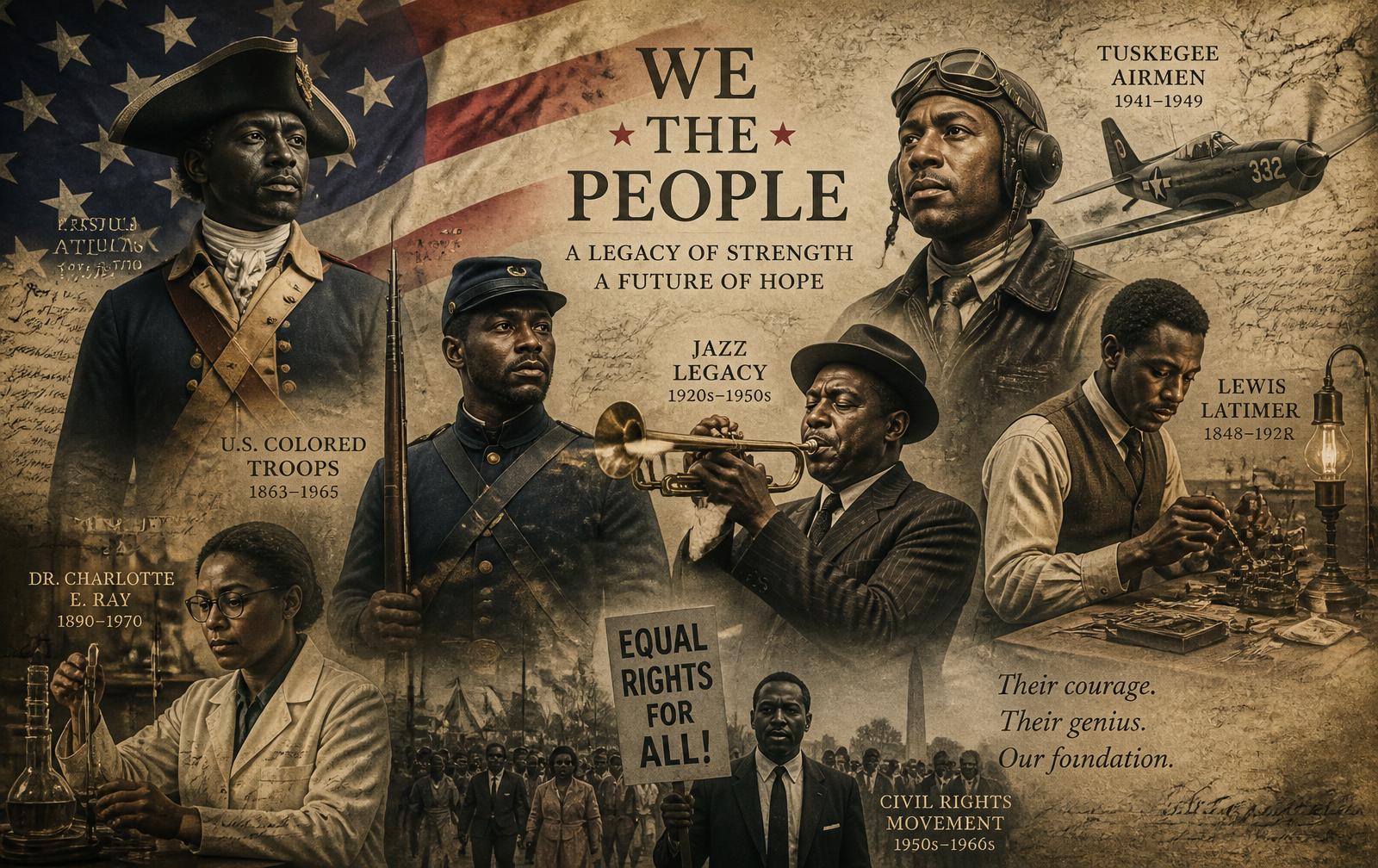
Foundational Black Americans were present at the very beginning of the American struggle for independence. On March 5, 1770, on King Street in Boston, a dockworker of African and Native descent named Crispus Attucks was the first of five men shot dead by British soldiers in what became known as the Boston Massacre. John Adams, defending the soldiers at trial, acknowledged Attucks as the leader of the crowd. Historians from the Boston Massacre Historical Society to the National Park Service recognize him as the first martyr of the American Revolution — a Black man whose death helped ignite the war for American independence.
Attucks was not alone. An estimated 5,000 to 8,000 Black soldiers and sailors served the Patriot cause during the Revolutionary War, according to records compiled by the National Archives and the Daughters of the American Revolution's Forgotten Patriots project. They fought at Lexington and Concord, at Bunker Hill, at Saratoga, and at Yorktown. The 1st Rhode Island Regiment, which included formerly enslaved men promised freedom for their service, held the line at the Battle of Rhode Island in 1778. Peter Salem, Salem Poor, Prince Estabrook, James Armistead Lafayette — these are names in the muster rolls of the American founding.
Enslaved Black Americans faced a decision no other colonists faced: which side, if either, offered a real chance at freedom. Thousands chose the British after Lord Dunmore's 1775 proclamation offered emancipation to enslaved men who fought for the Crown. Thousands more chose the Patriot cause. Either way, Black Americans fought for liberty from the first day of the Revolution — often the only people on the battlefield who were literally fighting for their own.
Saving the Union During the Civil War
Four score and seven years later, Foundational Black Americans were again decisive to the survival of the United States. The United States Colored Troops (USCT), established by the War Department in 1863, enlisted roughly 179,000 Black soldiers — about 10 percent of the entire Union Army — alongside nearly 20,000 Black sailors in the Union Navy. They served in 175 regiments and fought in more than 400 engagements, including 39 major battles. Roughly 40,000 died, three quarters of them from disease, and 25 received the Medal of Honor. (Sources: National Archives, "Black Soldiers in the U.S. Military During the Civil War"; U.S. National Park Service.)
The 54th Massachusetts Volunteer Infantry, one of the first official Black regiments, made its name at Fort Wagner in July 1863 under Colonel Robert Gould Shaw. Frederick Douglass — whose sons Lewis and Charles served in the regiment — recruited for it openly, arguing that "once let the black man get upon his person the brass letters U.S. … there is no power on earth which can deny that he has earned the right to citizenship."
Beyond the front line, Black Americans served as scouts, spies, engineers, teamsters, cooks, nurses, and laborers. Harriet Tubman led an armed raid at the Combahee River in June 1863 that freed more than 700 enslaved people — the first American military operation planned and led by a woman. Contraband camps organized by formerly enslaved refugees fed and repaired Union armies moving through the South.
Abraham Lincoln Acknowledges the Importance of Black Soldiers
By 1864, Abraham Lincoln — who had begun the war unwilling to touch slavery where it existed — was direct about who was winning it. In an August 1864 letter to Charles D. Robinson, Lincoln wrote that the Union depended on Black troops "and we can not spare the hundred and thirty thousand now serving us as soldiers, seamen, and laborers." In a September 1864 letter to Isaac Schermerhorn, he warned that abandoning emancipation would mean losing those men and losing the war. The line most often quoted — that without the military help of the Black freedmen, the war against the South could not have been won — reflects the same conclusion Lincoln stated repeatedly in his correspondence in the final year of the war.
Lincoln's views evolved because the record forced them to. He watched Black regiments fight at Port Hudson, Milliken's Bend, Fort Wagner, and the Crater. He read the casualty lists. Historians from Eric Foner to James McPherson have argued that Black military service was not merely helpful to Union victory but indispensable to it — and that this service is what made the Thirteenth, Fourteenth, and Fifteenth Amendments politically possible after the war. Black men earned citizenship on the battlefield before Congress wrote it into the Constitution.
Memorial Day
On May 1, 1865, less than a month after Appomattox, roughly 10,000 people — most of them formerly enslaved Black residents of Charleston, South Carolina — gathered at the site of a Confederate prison camp at the Washington Race Course. They had reburied 257 Union soldiers who died in captivity, built a fence around the new graveyard, and painted an archway reading "Martyrs of the Race Course." Black schoolchildren processed with flowers and sang "John Brown's Body." HistorianDavid W. Blight, working from a New York Tribune account and a Charleston Daily Courier report, has documented this ceremony as one of the earliest observances of what became Memorial Day.
Several American communities — Waterloo, New York; Boalsburg, Pennsylvania; Columbus, Georgia — also claim origination, and the federal government formally designated Waterloo in 1966. The historical evidence is mixed, and honest history can acknowledge multiple points of origin. What is not in dispute is that the Charleston ceremony happened, that it was organized by Black Americans, and that it was one of the first collective acts of national mourning for the Union dead.
Military Contributions Beyond the Civil War
The tradition did not end in 1865. In 1944, a private named Willie Lee Duckworth, marching with fellow Black soldiers at Fort Slocum, New York, improvised a call-and-response chant to keep exhausted troops in step. Colonel Bernard Lentz recorded it. The "Duckworth Chant" — "Sound off, one, two" — became the template for modern U.S. military marching cadences, adopted across every branch of service.
- Buffalo Soldiers (6th, 9th, 10th, 24th, 25th Regiments) — the peacetime regular Army units authorized by Congress in 1866, who served on the frontier, in Cuba, in the Philippines, and as some of the first rangers of America's national parks.
- Harlem Hellfighters (369th Infantry) — the World War I regiment that spent 191 days in front-line trenches, longer than any other American unit, and received the French Croix de Guerre.
- Tuskegee Airmen — the 332nd Fighter Group and 477th Bombardment Group of World War II, who flew more than 15,000 sorties and helped force the desegregation of the U.S. military in 1948.
- Doris "Dorie" Miller — the mess attendant at Pearl Harbor who manned an anti-aircraft gun on the USS West Virginia and became the first Black American awarded the Navy Cross.
- Medal of Honor recipients from every American war from the Civil War through Iraq and Afghanistan, including Sergeant William H. Carney, the first Black recipient, for saving the flag at Fort Wagner.
Music That Changed America
No cultural export has shaped the world's image of the United States more than its music, and virtually every genre of American popular music was created or fundamentally shaped by Foundational Black Americans.
- The Blues emerged in the Mississippi Delta in the late 19th century from field hollers, spirituals, and work songs of the formerly enslaved. It is the taproot of nearly every American popular genre that followed.
- Jazz was born in New Orleans in the early 1900s out of Black brass band, blues, and ragtime traditions. Louis Armstrong, Duke Ellington, Ella Fitzgerald, Miles Davis, John Coltrane — the Smithsonian's National Museum of African American History and Culture calls jazz "America's classical music."
- Gospel, formalized by Thomas A. Dorsey in 1930s Chicago, gave American religious music its modern voice.
- Rhythm & Blues, Soul, and Funk — the Ray Charles, Aretha Franklin, James Brown, Stevie Wonder lineage that produced Motown, Stax, and Philadelphia International.
- Rock and Roll was pioneered by Sister Rosetta Tharpe, Chuck Berry, Little Richard, Fats Domino, and Bo Diddley before Elvis Presley recorded a note. Chuck Berry's guitar vocabulary is the alphabet every rock guitarist since has spoken.
- Country music was shaped by Black musicians from its origins — the banjo itself is a West African instrument adapted in the Americas. DeFord Bailey was the Grand Ole Opry's first star. Lesley Riddle taught the Carter Family much of their repertoire. Charley Pride, Linda Martell, Ray Charles's Modern Sounds in Country and Western Music, and today Beyoncé's Cowboy Carter — the through-line is unbroken.
- Hip Hop, born at 1520 Sedgwick Avenue in the Bronx on August 11, 1973, is now the most-consumed genre in the world.
- Disco and House Music — emerged in the Black and Latino clubs of New York, Philadelphia, and Chicago in the 1970s and 80s — are the foundation of today's global electronic dance music industry.
Strip these traditions out of the American songbook and there is no Beatles, no Rolling Stones, no Bob Dylan going electric, no Eminem, no Taylor Swift transitioning to pop, no K-pop, no global EDM festival circuit. The American sound is a Black American sound the world learned to sing along to.
Medicine and Healthcare
- Dr. Daniel Hale Williams performed one of the first successful open-heart surgeries in 1893 at Provident Hospital in Chicago, an institution he founded.
- Dr. Charles Drew pioneered large-scale blood plasma preservation and organized the first mass blood banks for the Blood for Britain program and the American Red Cross during World War II. His research is the basis of modern transfusion medicine.
- Dr. Patricia Bath invented the Laserphaco Probe in 1986, revolutionizing cataract surgery and restoring sight to people who had been blind for decades.
- Dr. Alexa Canady became the first Black woman neurosurgeon in the United States in 1981 and led pediatric neurosurgery at Children's Hospital of Michigan.
- Dr. Ben Carson, at Johns Hopkins, led the first successful separation of craniopagus twins joined at the back of the head in 1987.
- Henrietta Lacks, whose cells were taken without her consent in 1951, produced the HeLa line — the first immortal human cell line and the foundation of the polio vaccine, in vitro fertilization, cancer research, and the COVID-19 vaccine development.
- Ernest Everett Just revolutionized cell biology and fertilization research in the early 20th century.
- Dr. Percy Julian synthesized cortisone and physostigmine from soybeans, making steroids affordable and treating glaucoma.
Engineering and Inventions
- Garrett Morgan — the three-position traffic signal (patented 1923) and the smoke hood that became the model for the gas mask.
- Granville T. Woods — the induction telegraph system that let moving trains communicate with stations, preventing countless collisions; he held nearly 60 patents.
- Lewis Latimer — the carbon filament that made Edison's light bulb practical and long-lasting, plus the drafting of Alexander Graham Bell's telephone patent.
- Elijah McCoy — the automatic lubricator for steam engines; the phrase "the real McCoy" refers to his patented original.
- Otis Boykin — the wire precision resistor used in pacemakers, guided missiles, and IBM computers.
- Lonnie Johnson — a NASA nuclear engineer who invented the Super Soaker, one of the best-selling toys in history, and holds more than 100 patents in propulsion and energy.
- Sarah Boone — an improved ironing board (patented 1892), one of the earliest patents granted to a Black woman.
- Madam C. J. Walker — founder of one of the first nationwide Black beauty-product empires and widely recognized as the first self-made woman millionaire in America.
- George Washington Carver — the Tuskegee scientist whose crop rotation and peanut research restored soil across the South and helped save Southern agriculture from post-cotton collapse.
- Frederick McKinley Jones — the refrigerated truck (Thermo King), which made the modern grocery-store supply chain possible.
- Marie Van Brittan Brown — the first home security system with closed-circuit television (patented 1969), the ancestor of every Ring doorbell.
- Mark Dean — IBM Fellow, co-inventor of the ISA bus, and part of the team that designed the first gigahertz computer processor. Three of the original nine IBM PC patents are his.
Patents and American Innovation
Foundational Black Americans have been awarded more than 50,000 U.S. patents across every field of American industry, from agricultural machinery to medical devices, telecommunications, and software. That number is a floor, not a ceiling: it rises every year as researchers continue to recover patents filed under initials, company names, or partners because individual inventors were barred from filing under their own names. The U.S. Patent and Trademark Office, the National Inventors Hall of Fame, and academic patent databases all document a continuous stream of Black American invention stretching back to the 19th century — proof that the country's innovation economy has depended on Foundational Black American ingenuity from the start.
Agriculture
The American South was rebuilt on Black agricultural knowledge. George Washington Carver's soil-conservation research at Tuskegee Institute rescued cotton-depleted farmland by teaching rotation with peanuts, sweet potatoes, and cowpeas. Enslaved and freed Black Americans brought and refined rice cultivation techniques in the Carolina Lowcountry, indigo processing, sugar refining, and animal husbandry — foundational skills that made colonial and antebellum American agriculture profitable. Booker T. Whatley later designed the community-supported agriculture (CSA) model that today's small farms still use.
Business and Entrepreneurship
- Madam C. J. Walker — beauty-product empire; first self-made female millionaire in America.
- Reginald F. Lewis — the first Black American to build a billion-dollar company, TLC Beatrice International, in the 1980s.
- John H. Johnson — founder of Johnson Publishing, Ebony, and Jet, and the first Black American on the Forbes 400.
- Earl G. Graves Sr. — founder of Black Enterprise, the definitive record of Black American business.
- Don Peebles — real-estate developer with more than $10 billion in projects across major U.S. cities.
- Robert F. Smith — founder of Vista Equity Partners, one of the largest private equity firms in the world.
- David L. Steward — founder of World Wide Technology, a multibillion-dollar tech services company.
- Cathy Hughes — founder of Urban One, the largest Black-owned broadcast company in America.
Science and Space
The mathematicians Katherine Johnson, Dorothy Vaughan, and Mary Jackson — the "hidden figures" of NASA Langley — calculated the trajectories that put John Glenn in orbit and sent Apollo to the Moon. Guion Bluford became the first Black American in space in 1983; Mae Jemison the first Black woman in space in 1992. Neil deGrasse Tysonand Ronald McNair — the physicist lost on Challenger — carried the tradition forward. Emmett Chappelle made key discoveries in bioluminescence that NASA still uses to detect life. Marian Croak holds foundational patents in Voice-over-IP that made modern internet calling possible. Dr. Kizzmekia Corbettwas a lead scientist on the mRNA COVID-19 vaccine at the NIH.
Literature and Education
The American literary canon without Frederick Douglass, Booker T. Washington, W. E. B. Du Bois, Zora Neale Hurston, Langston Hughes, Richard Wright, Ralph Ellison, James Baldwin, Gwendolyn Brooks, Toni Morrison, Maya Angelou, Alice Walker, August Wilson, and Ta-Nehisi Coates is not the American literary canon. Toni Morrison won the Nobel Prize in Literature in 1993. Carter G. Woodson, the "Father of Black History," founded Negro History Week in 1926 — the observance that became Black History Month. The nation's Historically Black Colleges and Universities (HBCUs) — Howard, Spelman, Morehouse, Hampton, Tuskegee, Fisk, and dozens more — have educated the majority of Black doctors, lawyers, judges, engineers, and officers in the country, on budgets a fraction of their predominantly white peers.
Civil Rights and the American Constitution
The United States Constitution is not what it was in 1787. It has been rewritten — by amendment, by Supreme Court decision, and by federal statute — largely because of Black American organizing. The 13th, 14th, and 15th Amendments, the Civil Rights Act of 1866, the Civil Rights Act of 1964, the Voting Rights Act of 1965, and the Fair Housing Act of 1968 all trace to Black American demands for the country to honor its founding language. Harriet Tubman, Sojourner Truth, Frederick Douglass, Ida B. Wells, A. Philip Randolph, Fannie Lou Hamer, Rosa Parks, Martin Luther King Jr., Ella Baker, Bayard Rustin, Thurgood Marshall, Constance Baker Motley, John Lewis, and Diane Nash did not weaken the Constitution. They completed it.
Sports
Jackie Robinson integrated Major League Baseball in 1947. Jesse Owens won four gold medals in front of Hitler in Berlin in 1936. Muhammad Ali, Joe Louis, and Jack Johnson defined boxing. Bill Russell, Wilt Chamberlain, Kareem Abdul-Jabbar, Michael Jordan, Magic Johnson, LeBron James, and Kobe Bryant defined basketball. Jim Brown, Walter Payton, Jerry Rice, and Barry Sandersdefined football. Serena and Venus Williams, Arthur Ashe, Althea Gibson transformed tennis. Tiger Woodstransformed golf. Simone Biles is the most decorated gymnast in history. American Olympic dominance in track and field is overwhelmingly a Foundational Black American story.
Food Culture
Southern cooking, soul food, American barbecue, Creole and Cajun cuisine, and much of what the world eats when it eats "American" was shaped by Foundational Black Americans in plantation kitchens, Freedmen's Bureau schools, Pullman dining cars, and family restaurants. Enslaved and freed cooks introduced or refined gumbo, jambalaya, hoppin' John, collards, cornbread, macaroni and cheese as a family dish (via Hercules and James Hemings, chefs to George Washington and Thomas Jefferson), sweet potato pie, and the low-and-slow smoking traditions that became American barbecue. When Americans eat Southern food, they are eating Black American food.
Language and Popular Culture
Everyday American English is shot through with Foundational Black American vocabulary and cadence: cool, hip, gig, jazz, groovy, dig it, my bad, throw shade, spill the tea, low-key, on point, vibe, slay, GOAT, cap, bet, deadass. The rhythms of stand-up comedy from Richard Pryor to Dave Chappelle, the choreography of American dance from tap to breaking to hip hop, the visual vocabulary of American fashion, and much of the meme economy of the modern internet come from Black American culture first.
Economic Contributions
For 246 years of American slavery and roughly 100 years of Jim Crow, Foundational Black Americans built the physical United States without a paycheck or with a discounted one — clearing land, laying rail, building the U.S. Capitol and the White House, picking the cotton that made the antebellum South the richest region on earth, and working the industrial North after the Great Migration. Since Emancipation they have added trillions of dollars in labor, taxes, consumer spending, patents, and enterprise. The Selig Center for Economic Growth estimates the Black American consumer market alone at more than $1.8 trillion annually — larger than the GDP of most nations.
The Numbers Game and the Origins of Modern Lottery Culture
In the late 19th and early 20th centuries, a form of daily lottery called "policy" or the "numbers game"flourished in Black neighborhoods in Chicago, Harlem, Detroit, and other cities. Because banks and mainstream investors excluded Black entrepreneurs, "policy kings" like Stephanie St. Clairin Harlem and the Jones Brothers in Chicago built organizations that employed thousands, financed Black-owned insurance companies, hotels, and newspapers, and circulated capital inside redlined communities. Historians including Nathan Thompson (Kings: The True Story of Chicago's Policy Kings) and Shane White(Playing the Numbers) have documented this economy in detail.
Beginning with New Hampshire in 1964, state governments legalized their own lotteries, and by the 1970s daily "Pick 3" and "Pick 4" games — nearly identical in structure to the numbers game — were widespread. State lotteries were established by state legislatures, not by the operators of the numbers game, and it would overstate the record to say that policy kings invented the modern lottery. What historians do note is that legal state games adopted the same three- and four-digit format, the same daily draw cadence, and much of the same clientele that Black-run games had cultivated for decades before them.
Overcoming Extraordinary Barriers
Every contribution above was made against the current of American law. Slavery denied literacy on penalty of death. The Black Codes criminalized unemployment. Jim Crow segregated the schools, the hospitals, the streetcars, and the courtroom. Redlining, formalized by the federal Home Owners' Loan Corporation in 1935, cut Black neighborhoods out of the mortgage market for generations. Convict-leasing extracted forced labor into the 20th century. The GI Bill's benefits were routinely denied to Black veterans. Universities excluded, employers excluded, unions excluded. The accomplishments in this article were built through that, not around it. That context is not a footnote — it is what makes the record extraordinary.
Common Myths, Answered by the Record
"Foundational Black Americans never invented anything."The United States Patent and Trademark Office has issued patents to Black Americans since at least Thomas Jennings in 1821. Garrett Morgan, Granville Woods, Lewis Latimer, Otis Boykin, Patricia Bath, Lonnie Johnson, and Marian Croak alone hold hundreds of patents that shape daily life on every continent.
"Black history begins with the Civil Rights Movement."Black history in what became the United States begins in 1619 at Point Comfort, Virginia. The Revolutionary War, the Constitution, the Civil War, Reconstruction, the Great Migration, and both World Wars are unintelligible without it.
"American culture developed independently of Black influence." American music, dance, comedy, food, sports, and vernacular English are unrecognizable without Foundational Black American contribution. The claim is not merely wrong — it is internally impossible.
Conclusion
America's success was built by many peoples: Indigenous nations whose land it occupies, European settlers, waves of immigrants from every continent, and Foundational Black Americans who were here before there was a United States and who fought in every war it has fought since. To recognize their contributions is not to diminish anyone else's. It is to tell the truth.
Understanding these contributions is not about diminishing anyone else's achievements. It is about recognizing a more complete and accurate history of the United States — one in which Foundational Black Americans helped shape the nation in profound and lasting ways.
Bibliography and Primary Sources
- National Archives, "Black Soldiers in the U.S. Military During the Civil War" — archives.gov
- Library of Congress, "African American Odyssey: A Quest for Full Citizenship" — loc.gov
- Smithsonian National Museum of African American History and Culture — nmaahc.si.edu
- National Park Service, "Crispus Attucks" and "Boston Massacre" —nps.gov/bost
- David W. Blight, Race and Reunion: The Civil War in American Memory (Harvard University Press, 2001) — Charleston 1865 Memorial Day ceremony.
- Eric Foner, Reconstruction: America's Unfinished Revolution, 1863–1877 (Harper & Row, 1988).
- James M. McPherson, The Negro's Civil War and Battle Cry of Freedom.
- Abraham Lincoln, Collected Works — letter to Charles D. Robinson (Aug. 17, 1864) and letter to Isaac M. Schermerhorn (Sept. 12, 1864).
- U.S. Army Center of Military History — Buffalo Soldiers, Harlem Hellfighters, Tuskegee Airmen, and Medal of Honor recipient records.
- Rebecca Skloot, The Immortal Life of Henrietta Lacks(Crown, 2010).
- Margot Lee Shetterly, Hidden Figures (William Morrow, 2016).
- Nathan Thompson, Kings: The True Story of Chicago's Policy Kings (Bronzeville Press, 2003); Shane White et al., Playing the Numbers: Gambling in Harlem Between the Wars(Harvard University Press, 2010).
- U.S. Patent and Trademark Office — searchable database of patents by Black American inventors.
- Selig Center for Economic Growth, University of Georgia —Multicultural Economy Report, annual editions.
- Daughters of the American Revolution, Forgotten Patriots: African American and American Indian Patriots in the Revolutionary War.
Share this article
Editorial standards: BlackCheck distinguishes verified facts, attributed claims, and open questions. Corrections are appended publicly to each piece.