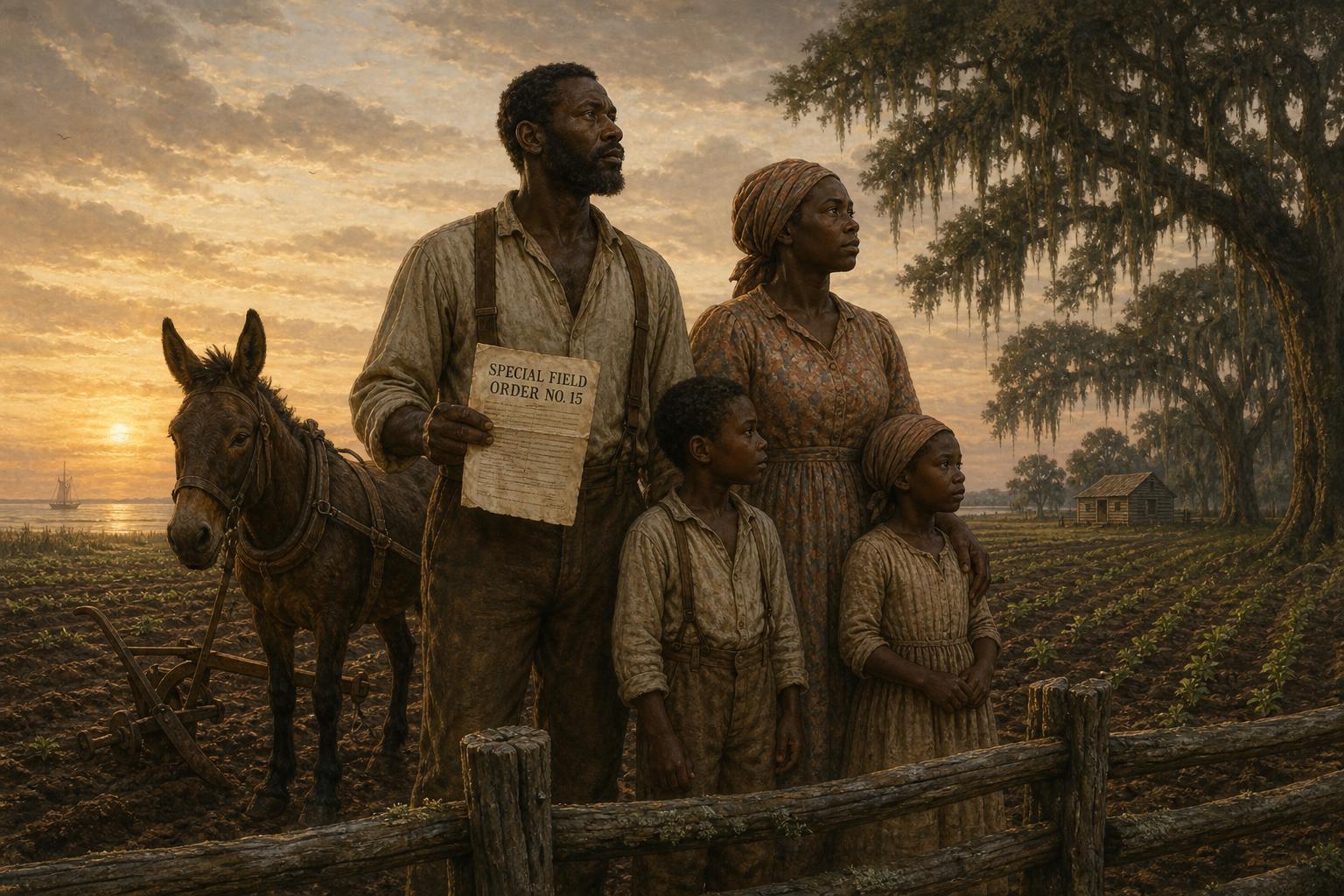
The phrase "forty acres and a mule" has become shorthand for a debt many Black Americans believe the United States never paid. The history behind that phrase is more specific — and in some ways more consequential — than the slogan suggests. It was a military order, not a federal law. It distributed real land to real families. And within a year, most of that land was taken back. The reparations debate that continues in 2026 is, in large part, a debate about what was promised in 1865, what was delivered, and what was reversed.
- Jan 12, 1865 — Sherman and Stanton meet with twenty Black ministers in Savannah.
- Jan 16, 1865 — Sherman issues Special Field Order No. 15.
- Mar 3, 1865 — Congress establishes the Freedmen's Bureau, authorizing 40-acre leases on abandoned lands.
- Apr 14, 1865 — Lincoln assassinated; Andrew Johnson becomes president.
- May–Sep 1865 — Johnson issues pardons and orders restoration of land to former Confederate owners.
- 1866 — Most Sherman-reservation families dispossessed; Southern Homestead Act passed but proves largely ineffective.
- 1989 — Rep. John Conyers introduces H.R. 40, a bill to study reparations proposals.
- 2021 — H.R. 40 passes the House Judiciary Committee for the first time.
1. Freedom After Slavery
When the Civil War ended in April 1865, roughly four million formerly enslaved people entered legal freedom. The 13th Amendment, ratified that December, abolished chattel slavery throughout the United States. But emancipation, as Frederick Douglass and others argued at the time, was the beginning of a question, not the end of one. Freedom without land, capital, or legal protection placed Freedmen in a precarious position — formally free, but economically dependent on the same planters who had owned them weeks earlier.
The expectation among many freed people that freedom would include land is documented in petitions, letters to the Freedmen's Bureau, and the records of meetings between Black community leaders and federal officials. It was not a fringe hope. It was an expectation rooted in specific federal actions taken in the war's final months.
2. The Origins of "40 Acres and a Mule"
On January 12, 1865, Secretary of War Edwin Stanton and General William Tecumseh Sherman met in Savannah, Georgia with twenty Black ministers, most of them formerly enslaved. The transcript of that meeting — preserved in the official records of the War of the Rebellion — records the ministers' answer to the question of what freed people most needed. Their spokesman, the Rev. Garrison Frazier, replied: "The way we can best take care of ourselves is to have land, and turn it and till it by our own labor."
Four days later, on January 16, 1865, Sherman issued Special Field Order No. 15. The order set aside a coastal strip roughly thirty miles inland from Charleston, South Carolina to the St. Johns River in Florida — including the Sea Islands — for settlement exclusively by freed Black families in plots "not more than forty acres of tillable ground." Sherman later authorized the Army to lend surplus mules to settlers, which is the origin of the second half of the phrase.
By June 1865, an estimated 40,000 freed people had settled on roughly 400,000 acres under the order. In March 1865, Congress passed the Freedmen's Bureau Act, which authorized the Bureau to lease abandoned and confiscated land to freed people in forty-acre plots, with an option to purchase after three years.
Three distinctions matter here, and they are often blurred in popular retellings:
- Special Field Order No. 15 was a military order, issued under Sherman's authority as a field commander. It was not a statute and not a constitutional amendment.
- The Freedmen's Bureau Act was federal legislation, but its land provisions applied only to abandoned and confiscated property and were temporary in nature.
- The popular expectation that land redistribution would become permanent national policy went beyond what either document formally guaranteed — but it was a reasonable reading of the direction federal policy appeared to be taking in early 1865.
3. Lincoln, Reconstruction, and Historical Reality
Abraham Lincoln's views on Reconstruction evolved across the war. His Ten Percent Plan, announced in December 1863, offered lenient terms for Confederate states to rejoin the Union but said little about the postwar status of freed people beyond emancipation. In his last public address, on April 11, 1865, Lincoln endorsed limited Black suffrage — specifically for "the very intelligent" and Black Union veterans — a position considered radical by many of his contemporaries but modest by the standards of what Radical Republicans were already proposing.
Lincoln did not sign Special Field Order No. 15 — Sherman issued it under military authority. Lincoln did sign the original Freedmen's Bureau Act on March 3, 1865. He did not, in the surviving record, commit himself publicly to permanent land redistribution as national policy before his death.
A question that recurs in public discussion is whether Lincoln was assassinated because he signed a reparations law. The short answer, according to mainstream historical scholarship, is no: there is no widely accepted historical evidence supporting that claim. The documentary record on John Wilkes Booth's motives — his diary, his letters, the testimony at the conspirators' trial, and his actions in the weeks before April 14, 1865 — points consistently to Confederate sympathies and to fierce opposition to Black citizenship and suffrage. Booth attended Lincoln's April 11 address and, according to witness testimony, told a companion afterward that the speech meant Black citizenship and that he would "put him through." No reparations statute signed by Lincoln has been identified in the federal record, because none existed.
That clarification does not weaken the reparations argument. The documented history is already substantial: a real military order distributing real land to real families, followed by a documented federal reversal under Lincoln's successor. The factual record carries the argument; speculation about the assassination does not.
"The way we can best take care of ourselves is to have land, and turn it and till it by our own labor."
4. Andrew Johnson and the Reversal
Andrew Johnson, a Tennessee Democrat who had remained loyal to the Union, succeeded Lincoln on April 15, 1865. Within weeks, Johnson began issuing pardons to former Confederates, including provisions for the restoration of property — explicitly including land already settled by Freedmen under Sherman's order.
In the late summer and fall of 1865, federal officials traveled to the Sea Islands to inform freed families that the land they had cleared and planted would be returned to its former Confederate owners. The most-cited episode took place on Edisto Island, South Carolina, in October 1865, when General Oliver Otis Howard, head of the Freedmen's Bureau, was sent personally to deliver the news. The freedpeople's committee responded with a petition that read, in part: "We have property in horses, cattle, carriages, and articles of furniture, but we are landless and homeless. From the homes we have lived in for the last three years we are about to be driven."
By 1866, the great majority of families settled under Special Field Order No. 15 had been dispossessed. The Southern Homestead Act of 1866, intended as a partial substitute, opened public lands in five Southern states to settlers including freed people, but the lands offered were largely marginal, the application process was poorly administered, and the program is generally judged a failure: only about 4,000 Black families ultimately obtained title, out of millions eligible.
5. Why Many Freedmen Viewed It as a Broken Promise
The sense of broken promise was not an inference made by later historians; it was articulated by Freedmen themselves at the time. Petitions preserved in Freedmen's Bureau records, articles in early Black newspapers, and testimony before congressional committees repeatedly describe a specific sequence: land was offered, families moved onto it and improved it, and then it was taken back.
The expectation extended beyond land. Reconstruction had created — briefly — meaningful access to the ballot, to public office, to federally funded schools, and to courts willing to hear Black plaintiffs. As that infrastructure was dismantled over the next thirty years, the cumulative effect was that promises which appeared, in 1865 and 1870, to be on the verge of being kept instead receded into formal rights without practical remedies.
6. The Economic Impact
Economists and historians who have attempted to estimate the long-term cost of denied land ownership generally arrive at large figures, even with conservative assumptions. The 400,000 acres distributed under Sherman's order represented a meaningful but small fraction of what would have been required to give every freed family a forty-acre plot — that figure would have been closer to 40 million acres, well within the scale of federal land holdings at the time.
Black landownership did grow after Reconstruction despite the reversal, peaking at roughly 15 million acres around 1910 through independent purchase, sharecropping savings, and homesteading. It then declined to under 3 million acres by the end of the twentieth century — a loss documented by the U.S. Department of Agriculture and studied extensively in the 1982 USDA report The Decline of Black Farming in America and subsequent academic literature. The compounding effect on generational wealth is the subject of ongoing research at the Federal Reserve, the Brookings Institution, and the Joint Center for Political and Economic Studies.
7. The Modern Reparations Debate
Contemporary discussion of reparations encompasses several distinct arguments, which are sometimes conflated in public debate. Three of the most commonly advanced are summarized below; each has serious advocates and serious critics.
Perspective one: compensation for historical harm
Reparations are framed as compensation for the cumulative harms of slavery, post-Reconstruction violence, Jim Crow, redlining, and discriminatory implementation of twentieth-century federal programs. Proponents include economists such as William Darity Jr. and A. Kirsten Mullen, whose 2020 book From Here to Equalityproposes a specific methodology for calculating and delivering payments to descendants of enslaved Americans.
Perspective two: fulfillment of Reconstruction-era promises
Reparations are framed as the delayed completion of obligations the federal government effectively created in 1865 and then withdrew — the land allocation under Special Field Order No. 15, the leasing provisions of the Freedmen's Bureau Act, and the protective framework of the Reconstruction amendments. This argument emphasizes specificity: it identifies an identifiable promise made by an identifiable government to an identifiable population.
Perspective three: structural and implementation concerns
Critics raise questions about eligibility (who qualifies, and how is descent documented), funding (which appropriations or trust mechanisms), legal authority (federal versus state), constitutional analysis (equal-protection considerations), and effectiveness (whether direct payments, institutional investment, or program-based remedies would best address the documented harms). These are policy and design questions rather than disputes over the underlying historical record, and they cut across ideological lines.
8. What Historians Agree On
Across the spectrum of mainstream historical scholarship, several points are not seriously contested:
- Reconstruction created unprecedented political, educational, and economic opportunities for Freedmen.
- Land redistribution occurred in limited but real forms — most notably under Special Field Order No. 15 and the Freedmen's Bureau Act.
- Most of those land allocations were reversed under Andrew Johnson, and most Sherman-reservation families were dispossessed by 1866.
- Many formerly enslaved people expected, with documentary basis, greater economic support than they ultimately received.
- The reparations debate, in some form, has been continuous since Reconstruction; it is not a recent invention.
Conclusion
Whether the reparations debate is primarily about compensation, historical accountability, the fulfillment of specific Reconstruction-era promises, or broader economic justice depends in part on which historical thread one chooses to follow. All four threads are anchored in documented events: a meeting in Savannah in January 1865, a military order four days later, a federal statute in March, an assassination in April, and a sequence of presidential pardons and restorations that followed.
The factual record is sufficient on its own. Readers do not need to accept any particular policy conclusion to recognize that promises were made, land was distributed, and the distribution was reversed. Those are the facts that the present debate inherits, and they are the facts on which any serious discussion of reparations — for or against — has to begin.
Selected sources and further reading: Special Field Order No. 15 (Jan 16, 1865); Edwin Stanton and W. T. Sherman, "Colloquy with Colored Ministers" (Savannah, Jan 12, 1865), in the Official Records of the War of the Rebellion, Ser. I, Vol. XLVII, Pt. 2; Freedmen's Bureau Act of 1865; Southern Homestead Act of 1866; petitions of the Edisto Island freedpeople (Oct 1865), Freedmen's Bureau records, NARA Record Group 105; Eric Foner, Reconstruction: America's Unfinished Revolution, 1863–1877(1988); W. E. B. Du Bois, Black Reconstruction in America(1935); William Darity Jr. and A. Kirsten Mullen, From Here to Equality (2020); USDA, The Decline of Black Farming in America (1982); H.R. 40 (introduced 1989, advanced 2021).
Share this article
Editorial standards: BlackCheck distinguishes verified facts, attributed claims, and open questions. Corrections are appended publicly to each piece.