A Jamaican can identify as Jamaican without being told that Jamaican identity must dissolve into a generic African identity. A Haitian can identify as Haitian. A Trinidadian can identify as Trinidadian. A Barbadian can be Barbadian. A Black Brazilian can speak about a distinctly Brazilian history. Nobody calls any of that division.
Every one of those identities sits comfortably alongside the broader racial label "Black" and alongside real connections to Africa. So here is the question this editorial sets out to examine: why does identifying a distinct Black American ethnic group — the descendants of the historic U.S. population that endured American slavery, emancipation, Reconstruction, Jim Crow, and the long civil-rights struggle — so often produce the accusation that someone is "dividing Black people"?
Race, Ethnicity, Nationality, Ancestry, Lineage
These words are not synonyms, and much of the confusion begins when they are treated as if they were.
- Race is a broad social classification, largely based on perceived physical traits and shaped by law and custom.
- Ethnicity refers to a group with a shared culture, history, language patterns, and sense of peoplehood.
- Nationality is a legal relationship to a state.
- Ancestry is where your forebears came from.
- Lineage is the specific, traceable line of descent — the family tree, and the history that happened to it.
The U.S. Census Bureau itself treats "Black or African American" as a racial category, and since the 2020 Census it has invited respondents to write in specific origins beneath it — Jamaican, Haitian, Trinidadian, Barbadian, and so on. In other words, the government already acknowledges that Black is not one ethnicity.
Black ≠ one ethnicity. A person can be Black and Jamaican. Black and Trinidadian. Black and Haitian. And Black and a Foundational Black American, or Black American Freedman.
Recognizing those differences does not deny shared experiences of racism, centuries of cultural exchange, political cooperation, or African ancestry. It simply refuses to pretend that a racial label tells you everything about a person's history.
Who Are Foundational Black Americans?
For purposes of this article, Foundational Black Americans (FBA) — also called Black American Freedmen, American Descendants of Slavery, or simply Black Americans — refers to an ethnic and lineage identity centered on the descendants of the historic Black population whose families were established in the United States through slavery, and who then lived through emancipation, Reconstruction, segregation, and the making of a distinctive Black American culture and political history.
Not everyone who uses these terms draws the boundaries identically. Advocates debate the labels themselves, how to treat people with mixed lineage, and how far back documentation must reach. Those debates are real and should be acknowledged rather than hidden.
What is not seriously in dispute is that this population developed a culture of its own on American soil: a distinct dialect (what linguists call African American English), the spirituals, blues, gospel, jazz, R&B, and hip hop; the Black church as an institution; foodways from the Low Country to the Delta; HBCUs, mutual aid societies, and Black towns; and a political tradition running from the Colored Conventions to the Movement. The Smithsonian's National Museum of African American History and Culture is, in large part, a museum of that specific people's history.
Why Does Delineation Become Controversial?
There is no single explanation that applies to everyone. Several forces are at work, and they deserve to be examined one at a time.
1. The legacy of the American racial system
For most of its history the United States sorted people primarily by race. Early censuses counted "free colored persons" and "slaves"; later ones used "Negro," "mulatto," "quadroon," and "octoroon" — categories concerned with degrees of "blood," not with culture or origin. The Census Bureau's own history of its race questions shows how thoroughly African origins were flattened into one racial bin.
Slavery itself did that flattening on purpose: enslaved people from many African nations were stripped of language, names, and kin. What emerged afterward in America was not a vague "Blackness" but a new people. Yet because the country spent centuries treating "Black" as if it were an ethnicity, many Americans — of every background — still hear "Black American" and "Black" as the same thing. Some of today's resistance to FBA delineation may simply be that habit talking.
2. Pan-Africanism and political solidarity
The strongest objection deserves a fair hearing. Pan-Africanist thinkers from Marcus Garvey to W.E.B. Du Bois argued that people of African descent worldwide share a common struggle against colonialism and white supremacy, and that unity multiplies power. Critics of lineage-based identity worry that emphasizing separate groups weakens that unity at exactly the wrong moment.
The counterargument is a single question: why should solidarity require ethnic erasure?
Irish, Italian, Polish, Greek, and Jewish Americans have kept distinct identities while voting, organizing, and building institutions together. African and Caribbean communities in the U.S. maintain national and ethnic associations while joining broader Black coalitions. Nobody claims a Haitian community center undermines Black unity.
The difference is between coalition and conflation. A coalition is distinct groups cooperating around shared interests. Conflation treats distinct groups as if their histories and interests were identical. Durable solidarity may actually depend on the first and be damaged by the second — because coalitions built on honest recognition do not collapse the moment interests diverge.
3. Immigration and demographic change
The Immigration and Nationality Act of 1965 ended national-origin quotas and, together with later refugee and diversity-visa programs, reshaped who is counted as Black in America. According to the Pew Research Center, roughly one in ten Black people in the United States is an immigrant, and that share has grown substantially since 1980, with large populations from Jamaica, Haiti, Trinidad, Barbados, and elsewhere.
That is not a problem; it is a fact. But it means the racial category "Black" increasingly includes Americans whose families have very different historical relationships to the United States. When the conversation turns to historical claims, cultural history, socioeconomic statistics, or remedies tied to specific events, demographic change makes lineage more relevant, not less.
4. The "flat Blackness" question
Call it flat Blackness: treating everyone racially classified as Black as one interchangeable ethnic population. What information disappears when multigenerational Black Americans, recent African immigrants, Caribbean immigrants, and Afro-Latinos are merged into a single statistical line?
Potentially, differences in:
- ancestry and immigration history
- household income and wealth
- educational attainment
- geographic concentration
- historical exposure to U.S. discrimination — redlining, Jim Crow, exclusion from New Deal programs
- intergenerational wealth transfer
- cultural background
These differences do not always exist, and when they do they do not always point the same direction. Pew's research on the growing diversity of Black America shows variation by nativity in education and other measures. Selective immigration — people who qualified for visas, often with degrees — will naturally shape group averages. That is precisely why aggregation can mislead.
Aggregation is useful when the question is about race itself: how police treat Black drivers, how landlords respond to Black applicants. Racism does not check passports. But disaggregation produces a more accurate picture when the question is about the long-term effects of specific American policies on the specific people those policies targeted.
5. Reparations and lineage-specific public policy
Delineation becomes most consequential in the reparations debate, which turns on a distinction between race-based eligibility (anyone classified as Black) and lineage- or harm-based eligibility (people descended from those directly harmed by slavery and subsequent government-sanctioned discrimination).
In March 2022 the California Reparations Task Force voted, narrowly, to limit eligibility for its proposals to descendants of enslaved African Americans or free Black people living in the U.S. before the end of the 19th century — a lineage standard, not a race standard. The long-running federal bill H.R. 40 would create a commission to study slavery and its continuing effects. Legal scholars have also noted that race-only programs face heavier constitutional scrutiny, while remedies tied to a documented historical injury rest on different ground.
BlackCheck does not dictate the policy outcome here. But the logic is hard to escape: a remedy intended to address a historically specific government action logically requires identifying the population connected to that history.
6. The "destiny swapping" argument
Within some lineage-based discourse, the term destiny swapping describes a concern — a claim, not an established fact — that when every Black population is merged into one identity, the achievements, grievances, cultural contributions, and claims to remedy associated with one population can be attributed to or claimed on behalf of the whole.
Is there evidence of conflation? Some, and it is often institutional rather than personal. A frequently cited example is a 2004 New York Times report on research presented by Harvard scholars, which found that a disproportionate share of Black students at Harvard were immigrants or children of immigrants — raising the question of whether affirmative action, justified largely by the history of American slavery and segregation, was reaching the descendants of that history.
It matters to separate the possible causes:
- deliberate misrepresentation
- institutional classification practices that record only "Black"
- media simplification
- cultural exchange, which is normal and healthy
- genuine misunderstanding
- ordinary racial solidarity
There is no evidence that entire immigrant or ethnic populations are intentionally appropriating anyone's history, and this publication does not make that accusation. The stronger question is structural: does an identity system that treats all Black populations as interchangeable make historical misattribution easier, regardless of anyone's intentions? The answer appears to be yes.
7. Is the opposition really fear of delineation?
We should challenge our own premise. Critics of FBA and Freedmen delineation raise a range of concerns, including:
- political fragmentation of the Black vote and Black organizations
- fear that the movement could slide into xenophobia toward African and Caribbean immigrants
- exclusion of people with mixed or hard-to-document lineage
- disagreement over terminology and who coined it
- competing concepts of Black identity and Pan-African ideology
- confusion between race and ethnicity
- concerns about reparations eligibility
- resistance to changing long-established racial categories
Some of these are serious. Xenophobia is a real risk in any identity movement, and FBA advocates should reject it plainly. Documentation gaps are real because slavery destroyed records on purpose. But most of these concerns argue for careful delineation, not for no delineation. None of them explains why Black Americans alone should be expected to have no ethnic name.
Nobody Tells Jamaicans They Can't Be Jamaican
Acknowledging Jamaican, Haitian, Trinidadian, or Barbadian identity does not require anyone to deny that they are also Black or of African descent. Both layers coexist without controversy. A Haitian American can attend a Kanaval celebration on Saturday and a Black voter-registration drive on Sunday, and no one calls it a contradiction.
So the questions write themselves:
Why should acknowledging a distinct Black American ethnic identity require abandoning broader Black solidarity?
Why can't Black Americans possess both a specific ethnic identity and a broader racial identity, just as every other group does?
Delineation Is Not the Same Thing as Division
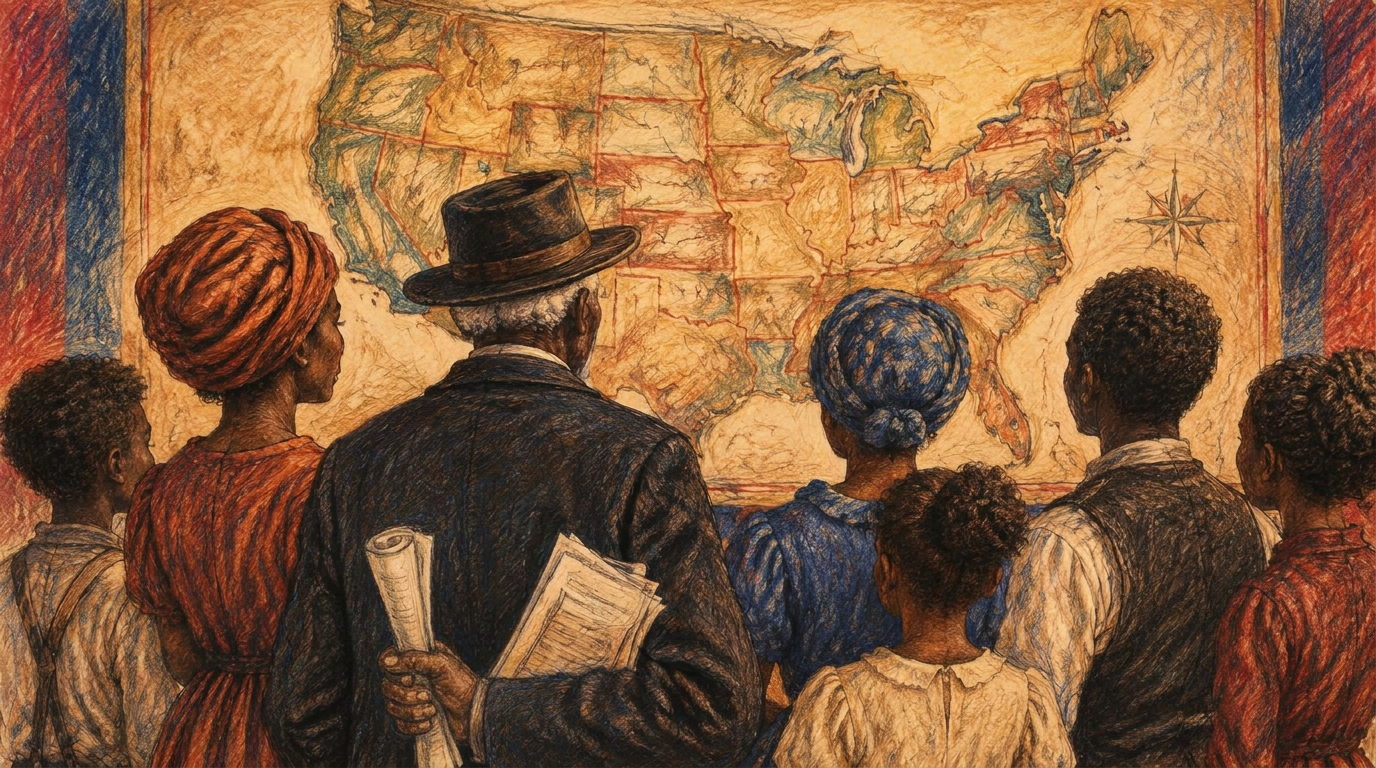
A map needs borders. Not because the neighboring states are enemies, but because the lines let us understand what we are looking at. Delineation works the same way: it identifies different histories without declaring any population superior or inferior.
That last point must be non-negotiable. Ethnic specificity should not become ethnic hierarchy. Asking lineage questions is legitimate. Hostility toward Africans, Caribbean people, Afro-Latinos, or any other Black ethnic population is not, and it betrays the very principle that justifies FBA identity — that every people deserves to be seen accurately.
The More Revealing Question
Perhaps the important question is not:
"Why are Black Americans dividing Black people by delineating?"
Perhaps the more revealing question is:
"Why was a racial category ever expected to erase the ethnic identity of the people whose history created that category in the United States?"
If Jamaicans can be Jamaican, Haitians can be Haitian, Trinidadians can be Trinidadian, and Barbadians can be Barbadian while still participating in a broader Black identity, why should the descendants of America's historic Black population be the exception?
Sources and Further Reading
- U.S. Census Bureau — Measuring Race and Ethnicity Across the Decades, 1790–2020
- Pew Research Center — A rising share of the U.S. Black population is foreign born
- Pew Research Center — The Growing Diversity of Black America
- U.S. Office of the Historian — Immigration and Nationality Act history
- California Task Force to Study and Develop Reparation Proposals — Final Report
- Congress.gov — H.R. 40
- National Archives — Freedmen's Bureau Records
- Smithsonian National Museum of African American History and Culture
Share this article
Editorial standards: BlackCheck distinguishes verified facts, attributed claims, and open questions. Corrections are appended publicly to each piece.