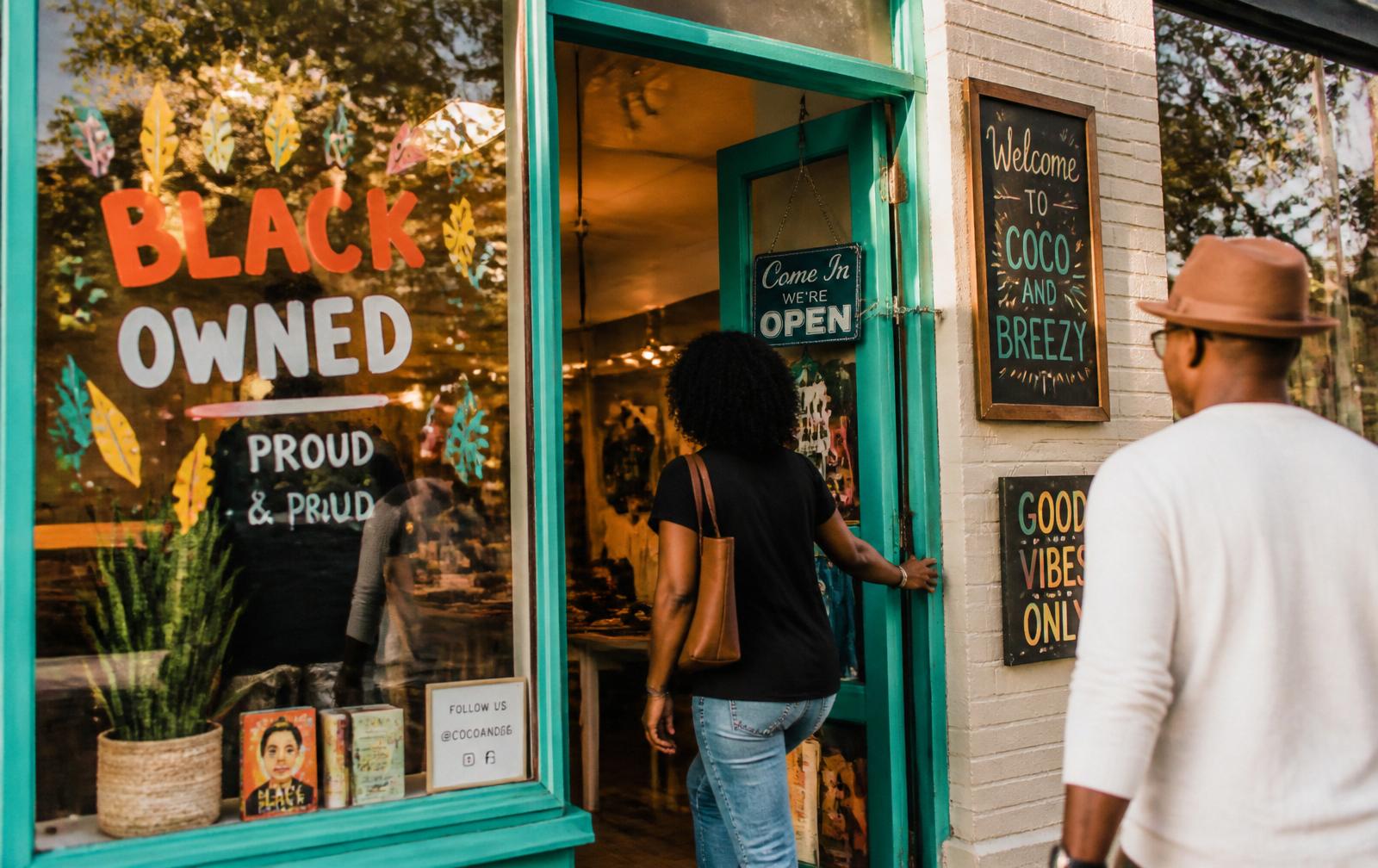
Every dollar tells a story. It travels from a customer's hand to a cash register, then to payroll, suppliers, landlords, and lenders — and somewhere along that journey, it either stays in a community or leaves it. For Foundational Black Americans, that simple economic fact sits at the center of an old conversation made new again: what does it mean to intentionally support Black-owned businesses, and why is the same practice that is celebrated in other communities sometimes misunderstood when Black Americans do it?
This is an opinion piece grounded in publicly available research and the lived experience of Black entrepreneurs. It argues a single, narrow thesis: buying Black is not anti-anyone. It is a community-building strategy, a wealth-retention strategy, and an American tradition practiced by nearly every ethnic group that has ever built a neighborhood in this country.
Section 1: The Importance of Economic Circulation
Economists have long studied how money circulates within a local economy. The concept is sometimes called the "local multiplier effect": when consumers spend at locally owned, independent businesses, a larger share of each dollar recirculates within the community through local wages, local suppliers, and local services. Civic Economics studies in cities including Salt Lake City, New Orleans, and Grand Rapids have consistently found that independent retailers recirculate a significantly higher share of revenue locally than national chains — often two to four times more, depending on the category.
Small businesses are also the backbone of American employment. The U.S. Small Business Administration's Office of Advocacy reports that small firms account for roughly 99.9% of U.S. businesses and have historically generated a majority of net new private-sector jobs. When a community owns more of its commercial base, more of the jobs, contracts, and wealth created by that base stay close to home.
Generational wealth follows the same pattern. The Federal Reserve's Survey of Consumer Finances has repeatedly documented a wide racial wealth gap in the United States, with median white family wealth many times greater than median Black family wealth. Business ownership and home equity are the two largest engines of wealth formation for middle-class American families. A community that owns more of its businesses and more of its real estate accumulates more wealth, period.
This is why nearly every ethnic community in America — Italian, Jewish, Greek, Korean, Vietnamese, Cuban, Nigerian, Indian, and many others — has, at various points, encouraged its members to patronize co-ethnic businesses. The practice is not unusual. It is one of the most well-documented strategies in American economic history for how an immigrant or marginalized community moves from arrival to prosperity.
Section 2: The Black Hair Care Industry
Few industries illustrate the stakes more clearly than Black hair care. The modern Black beauty industry traces directly to Black American innovators. Annie Turnbo Malone built one of the first national Black hair-care companies in the early 1900s. Madam C.J. Walker, who trained with Malone before launching her own company, became one of the first self-made female millionaires in American history by building a coast-to-coast network of sales agents and beauty schools. Pioneers including S.B. Fuller, George E. Johnson (Johnson Products, makers of Ultra Sheen and Afro Sheen), and the family behind Soft Sheen built billion-dollar categories from scratch.
Beginning in the late 20th century, however, ownership of the retail and wholesale channels that distribute Black hair-care products shifted dramatically. Multiple journalistic investigations and academic studies — including reporting by NPR, the documentary Black Hair by Aron Ranen, the film Good Hair, and academic work by scholars such as Robert Mark Silverman of the University at Buffalo — have documented that a large share of beauty supply stores serving Black consumers in the United States are owned by Korean American entrepreneurs, with much of the wholesale distribution network historically concentrated among a small number of importers.
Black entrepreneurs who have tried to enter the beauty-supply retail and wholesale space have raised concerns in the trade press and in state-level hearings about uneven access to wholesale accounts, inventory, and product lines. Independent retailers such as Sam Ennon of the Black Owned Beauty Supply Association have spent decades advocating for broader access to distribution. Others — including beauty entrepreneurs like Devin Robinson and the founders of brands such as Mielle Organics, Pattern Beauty, The Lip Bar, and The Honey Pot — have built successful alternative supply chains and direct-to-consumer brands.
These are complicated questions, and reasonable people disagree about causes and remedies. What is not in dispute is that the original innovators of an entire industry deserve a meaningful seat at the table of its modern economics, and that Black entrepreneurs attempting to build in this category face structural challenges that warrant honest, sourced discussion.
Section 3: Community Investment
Beyond the storefront itself, residents of predominantly Black neighborhoods sometimes raise concerns when businesses operating in their communities show limited engagement with local institutions — for example, by not hiring locally, not sponsoring youth programs, and not supporting neighborhood nonprofits. These concerns are not unique to any one ethnic group of business owners; they are raised about absentee corporate chains, out-of-town landlords, and any operator whose footprint in the neighborhood is purely transactional.
Community investment can take many concrete forms:
- Hiring local residents and paying competitive wages
- Sponsoring youth sports, scholarships, and after-school programs
- Donating to local schools, churches, and nonprofits
- Supporting neighborhood festivals and small-business associations
- Participating in local chambers of commerce and economic-development efforts
- Investing in storefront maintenance and the physical character of the block
Many businesses — Black-owned and otherwise — do all of these things well. Many do not. It is fair for any community to ask the businesses operating in it to be partners in its long-term health, and it is equally important to avoid sweeping generalizations about any ethnic group. Practices vary widely between individual owners and companies, and the conversation should focus on practices, not ethnicities.
Section 4: Why Support Black-Owned Businesses?
The case for intentionally supporting Black-owned businesses rests on the same logic that supports any "buy local" movement, with additional context drawn from American history. The arguments most commonly made by advocates include:
- Job creation. Black-owned firms employ disproportionately more Black workers. Research by the Joint Center for Political and Economic Studies and others has shown that Black-owned employer firms hire Black employees at rates significantly higher than non-Black-owned firms.
- Wealth retention. Profits from locally owned businesses become local investment — homes, college tuition, second businesses, and intergenerational transfers.
- Entrepreneurship pipelines. Successful Black-owned businesses become mentors, suppliers, and capital sources for the next generation of Black entrepreneurs.
- Local ownership. Owners who live in or near the community they serve tend to make decisions that reflect community interests.
- Community pride and visibility. Visible, successful Black-owned enterprises reshape young people's sense of what is possible.
- Economic mobility. Business ownership is one of the most reliable paths from working class to middle class to wealth in American economic history.
The numbers underscore the opportunity. According to Brookings Institution analysis of the U.S. Census Annual Business Survey, Black Americans make up roughly 14% of the U.S. population but own only about 3% of U.S. employer businesses. Closing that gap is not charity. It is one of the largest untapped sources of economic growth in the country.
Section 5: Comparing Other Communities
America loves an ethnic enclave — when it's someone else's. Tourists flock to Chinatown in San Francisco and New York. Koreatown in Los Angeles is a globally recognized brand. Little Haiti, Little Saigon, Little Italy, Little Havana, Little Nigeria, Devon Avenue's South Asian corridor in Chicago, the Cuban business district along Calle Ocho in Miami — these places are celebrated as cultural treasures, engines of small-business formation, and proof that the American promise works.
Each of these neighborhoods exists, in part, because members of those communities consciously supported businesses owned by their own. Co-ethnic patronage helped early-stage businesses survive their first lean years. Community-based lending circles — tandas, sou-sous, kyes, gye, hui — provided startup capital. Cultural festivals drew outside visitors and additional revenue. These are not secrets; they are case studies taught in business schools.
Foundational Black Americans ask a fair question: when our community attempts the same time-tested strategy — Black Wall Street in Tulsa, Sweet Auburn in Atlanta, U Street in Washington, Bronzeville in Chicago, the Hayti district in Durham — why is the encouragement to "buy Black" sometimes met with suspicion rather than celebration? Reasonable people can disagree about the answers, but the question itself deserves to be taken seriously instead of dismissed.
Section 6: Is Buying Black Racist?
It is worth being precise. Supporting businesses within one's community is not the same as excluding people based on race.
- A Black-owned business that welcomes all customers is not discriminating against anyone.
- A consumer who chooses to spend at a Black-owned bookstore, restaurant, or contractor is exercising consumer choice — the same choice every American exercises every day when picking where to shop.
- An economic-development initiative that prioritizes capital access, mentorship, and procurement opportunities for historically underinvested communities is repair, not exclusion.
Civil-rights law in the United States protects people from discrimination in employment, housing, lending, and public accommodations. It does not — and should not — require any consumer to spread their personal spending evenly across every demographic group. No one suggests that Italian Americans patronizing an Italian bakery, or Korean Americans supporting a Korean grocer, are engaged in racism. The same standard fairly applies to Black Americans.
Critics raise a different concern worth acknowledging: that framing any consumer movement in racial terms risks hardening lines in an already polarized country, and that the most durable version of "buy local" is one that ultimately invites broad cross-community participation. That critique has merit — and it is fully compatible with intentional support for Black-owned businesses. The two ideas coexist in every other ethnic enclave in America.
Section 7: Building Stronger Communities
The most productive version of this conversation focuses on solutions. Several are already working:
- Starting and scaling businesses. Organizations like the U.S. Black Chambers, Inc., the National Minority Supplier Development Council, and Operation HOPE provide infrastructure for Black entrepreneurs at every stage.
- Capital access. Community Development Financial Institutions (CDFIs), Black-owned banks such as OneUnited, Liberty Bank, and Carver Federal Savings, and minority-focused venture funds like Harlem Capital and Collab Capital are expanding the capital pipeline.
- Cooperative economics. Cooperative buying clubs, investment clubs, and lending circles allow households to pool resources for larger goals — a practice deeply rooted in Black mutual-aid tradition documented by scholars like Jessica Gordon Nembhard in Collective Courage.
- Financial literacy and workforce development.Programs run by HBCUs, the National Urban League, and local nonprofits build the foundational skills that turn earners into owners.
- Procurement. Corporate and government supplier-diversity programs — when honestly implemented — move meaningful contract dollars to Black-owned firms.
The examples of success are real and growing: World Wide Technology (David Steward), a multi-billion-dollar IT firm; RLJ Companies and BET (Robert L. Johnson); Johnson Publishing (John H. Johnson), which builtEbony and Jet magazines; Black Enterprise (Earl Graves Sr.); Urban One (Cathy Hughes); Magic Johnson Enterprises (Earvin "Magic" Johnson); Slutty Vegan (Pinky Cole); the ACT-1 Group (Janice Bryant Howroyd); Vista Equity Partners (Robert F. Smith); Tyler Perry Studios; Entertainment Studios (Byron Allen); and thousands of profitable, civically engaged small businesses on Main Streets across the country.
Suggested Visualizations
- Infographic: "How a Dollar Circulates" — comparing local-multiplier estimates for independent vs. chain retailers.
- Chart: Share of U.S. population vs. share of U.S. employer firms by race/ethnicity (source: Annual Business Survey).
- Timeline: Milestones in Black entrepreneurship from Annie Turnbo Malone to today's leading Black-owned brands.
- Map: Historic Black business districts — Greenwood, Sweet Auburn, U Street, Bronzeville, Hayti, Jackson Ward.
Conclusion
Economic empowerment is most effective when it is constructive. It builds businesses. It creates jobs. It expands opportunity. It strengthens neighborhoods. It does not require diminishing anyone else's dignity, rights, or livelihood, and the most successful Black-owned businesses in America are proof of that — they serve diverse customers, employ diverse workforces, and still anchor the communities that built them.
Buying Black, supporting local entrepreneurs, investing in Black-owned banks, joining a cooperative, mentoring a young founder, learning to read a balance sheet, opening a business of your own — these are American practices in the most ordinary sense. They are how communities have always built themselves up in this country. Foundational Black Americans are not asking for anything that has not already been encouraged for every other group. We are simply asking that the same strategy, applied to our own community, be understood for what it is: community building.
Sources and Further Reading
- U.S. Small Business Administration, Office of Advocacy — annual small-business profiles and FAQs.
- Federal Reserve, Survey of Consumer Finances — racial wealth gap analyses.
- Civic Economics — local-multiplier studies (Salt Lake City, New Orleans, Grand Rapids).
- Brookings Institution — analyses of Black business ownership using the U.S. Census Annual Business Survey.
- Joint Center for Political and Economic Studies — research on Black-owned employer firms and hiring patterns.
- Jessica Gordon Nembhard, Collective Courage: A History of African American Cooperative Economic Thought and Practice.
- Robert E. Weems Jr., Desegregating the Dollar: African American Consumerism in the Twentieth Century.
- A'Lelia Bundles, On Her Own Ground: The Life and Times of Madam C.J. Walker.
- Aron Ranen, Black Hair (documentary); Chris Rock, Good Hair (documentary).
This piece is opinion grounded in cited research. Where claims reflect interpretation rather than settled fact, language has been chosen to make that distinction clear.
Share this article
Editorial standards: BlackCheck distinguishes verified facts, attributed claims, and open questions. Corrections are appended publicly to each piece.