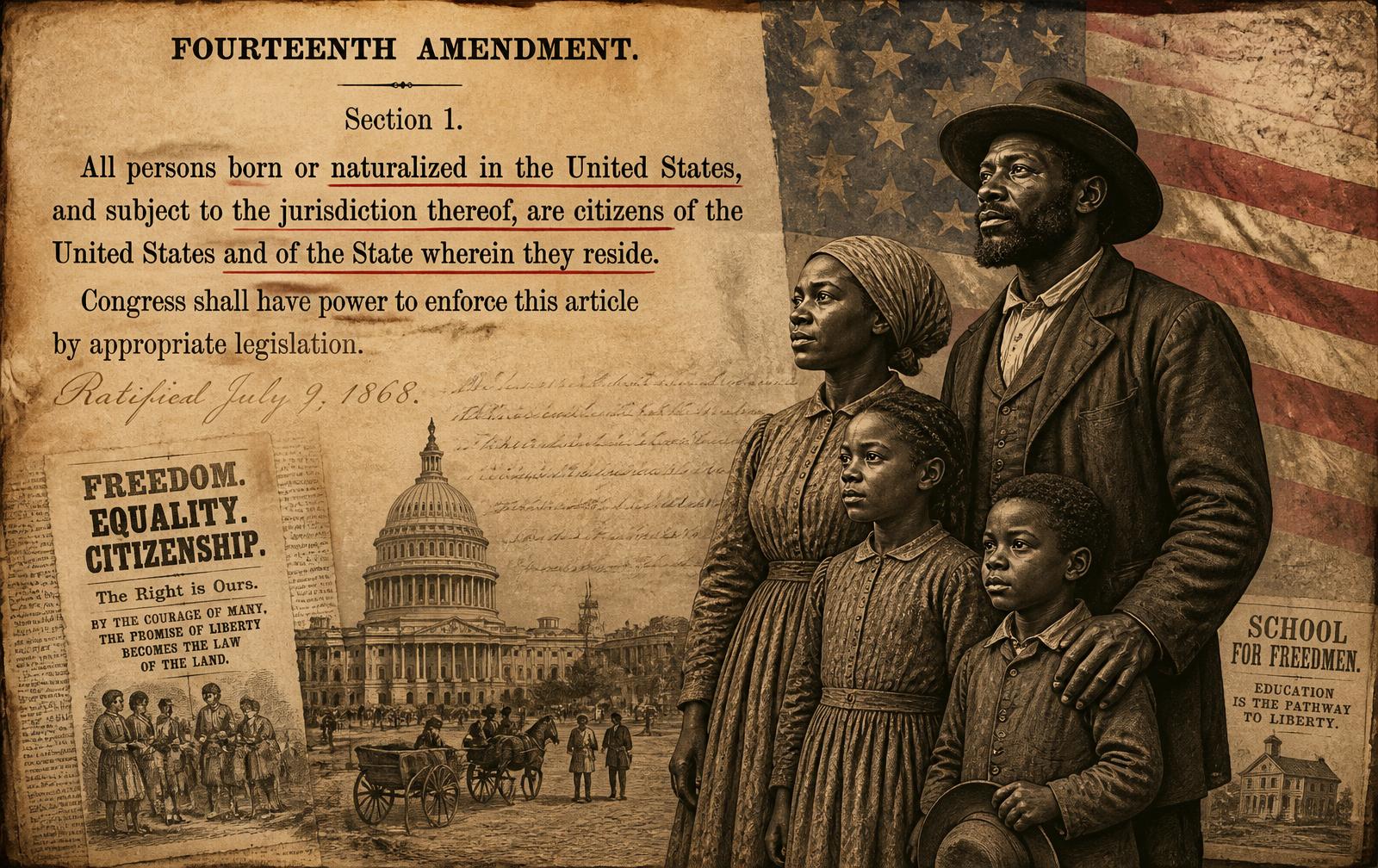
The country is arguing about birthright citizenship again. Executive orders have been signed, injunctions have been issued, appeals have been filed, and cable panels have discovered the Fourteenth Amendment the way people discover a fire exit — suddenly, and only because something is burning. But there is a part of this argument that almost nobody on television is saying out loud, and it belongs to us. The Citizenship Clause of the Fourteenth Amendment was not written with modern immigration in mind. It was written because the United States had to decide, once and for all, whether the descendants of the people it enslaved were Americans.
Trump did not create this history. His challenge to modern birthright citizenship simply forced America to look at it again.
Before It Was an Immigration Argument, It Was a Black American Argument
Start where the record starts. In 1857, in Dred Scott v. Sandford, Chief Justice Roger B. Taney wrote for the Supreme Court that Black people of African descent whose ancestors were brought here and sold as slaves were not, and could not become, citizens of the United States. The opinion went further than the case required. It declared that Black Americans had, in the framers' understanding, "no rights which the white man was bound to respect," and it held that Congress lacked power to bar slavery from the federal territories.
Read that carefully. The Court was not talking about newcomers. It was talking about a population that had been on this soil for more than two hundred years by 1857 — a population that had cleared the fields, built the ports, fought in the Revolution, and produced children, churches, and cemeteries on American ground. The highest court in the land looked at people who had been here since the colonial period and told them they were not, and could never be, citizens of the only country they had ever known.
Dred Scott did not settle the slavery question. It detonated it. Within four years the country was at war with itself. The Emancipation Proclamation followed in 1863, the Thirteenth Amendment abolished slavery in 1865, and then came the hard part: emancipation is not citizenship. Four million people were suddenly free and legally undefined. Southern legislatures answered that vacuum with the Black Codes — statutes that criminalized unemployment, restricted movement, controlled labor contracts, and rebuilt bondage under a new name.
The Civil Rights Act of 1866 and the Fear That Followed It
Congress responded with the Civil Rights Act of 1866, which opened with language nobody should have to search for: "All persons born in the United States and not subject to any foreign power, excluding Indians not taxed, are hereby declared to be citizens of the United States." President Andrew Johnson vetoed it. Congress overrode the veto — the first successful override of a presidential veto on a major bill in American history.
But the men of the Thirty-Ninth Congress understood something about statutes: a later Congress can repeal them, and a hostile Court can gut them. If Black citizenship rested only on an act of legislation, it would last exactly as long as the political coalition that passed it. So they wrote it into the Constitution instead. The Fourteenth Amendment was proposed in 1866 and ratified in 1868, and its very first sentence is the answer to Taney:
"All persons born or naturalized in the United States, and subject to the jurisdiction thereof, are citizens of the United States and of the State wherein they reside."
That sentence overruled Dred Scott by constitutional text. This is not an interpretation, and it is not an opinion piece talking point. It is the documented purpose of the clause, stated repeatedly on the floor of Congress during the debates of 1866 and confirmed by the Supreme Court itself in later decisions describing the amendment's origins.
The Honest Part: The Clause Grew Beyond Its Origin
Now the part that intellectual honesty requires, because BlackCheck does not win arguments by shading the record. The Citizenship Clause is not legally limited to Foundational Black Americans, and anyone telling you that a court has ruled otherwise is selling you something.
In 1898, in United States v. Wong Kim Ark, the Supreme Court held that a man born in San Francisco to Chinese parents who were themselves barred from naturalizing was a citizen of the United States by birth. The Court grounded that holding in the English common-law rule of jus soli — citizenship by soil — which it read the Fourteenth Amendment as having constitutionalized. That decision, not the Reconstruction debates alone, is the legal spine of modern birthright citizenship. Later cases layered on top of it. The clause today reaches far past the population whose exclusion prompted it.
Here is the argument that is both defensible and powerful, and it does not require bending a single fact: the fact that the Citizenship Clause has since been applied to other populations does not erase the population whose citizenship crisis created it. A law can outgrow its origin without losing it. The Fourteenth Amendment protects tens of millions of people who have no ancestral connection to American slavery, and it should. But it exists because of us.
What the Executive Orders Actually Do — and Cannot Do
President Trump's executive action on birthright citizenship, signed at the outset of his second term, directs federal agencies to stop issuing or recognizing documents of U.S. citizenship for certain children born on American soil — specifically where the mother is unlawfully present or lawfully present only temporarily, and the father is neither a citizen nor a lawful permanent resident. The administration's legal theory rests on the phrase "subject to the jurisdiction thereof," arguing that the clause was never meant to confer citizenship on the children of people with no durable allegiance to the United States, and pointing to practices commonly described as birth tourism.
That theory has not fared well in court. Federal district judges blocked the order almost immediately, appellate courts have largely sustained those blocks, and the litigation has continued through the Supreme Court on procedural questions about the scope of injunctions as much as on the merits of the clause itself. The dispute is live and unresolved as of this writing.
So let us be precise, because precision is the whole point of this publication. An executive order cannot amend the Constitution. It cannot overrule Wong Kim Ark. It cannot, by itself, redefine who is a citizen. What it can do — what it has already done — is force a national argument about the origin and meaning of a sentence most Americans have never read. And when America goes looking for the origin of that sentence, the trail does not lead to a visa office. It leads to Reconstruction. It leads to the Black Codes. It leads to Dred Scott.
We Were Already Here
We were not foreigners standing outside America waiting for the Fourteenth Amendment to invite us inside. Our ancestors were already here. They had worked this land, built communities, fought in America's wars, produced American culture and endured generations of American slavery. The constitutional question after emancipation was whether the country they helped build would finally recognize them as citizens.
The answer of Reconstruction was the Fourteenth Amendment.
That answer was not generosity. It was overdue arithmetic. Crispus Attucks fell on King Street in 1770. Black soldiers served at Bunker Hill and Yorktown. Roughly 180,000 Black men served in the United States Colored Troops and helped decide the outcome of the Civil War — a fact Abraham Lincoln himself acknowledged when he wrote that without Black manpower the Union could not have been preserved. The country did not confer citizenship on strangers in 1868. It finally acknowledged a debt to people who had been acting like citizens for two centuries without the paperwork.
The Sequence Matters
Before birthright citizenship became an immigration argument, it was a Black American citizenship argument.
Before today's debates about undocumented immigration, birth tourism, or temporary visas, there was Dred Scott.
Before Americans were debating whether someone could travel to the United States and obtain citizenship for a child through birth, America was debating whether millions of Black people whose families had been here for generations could be citizens at all.
That historical sequence matters. Not because it settles the current litigation — it does not, and we are not pretending otherwise — but because a country that argues about a constitutional clause without knowing why the clause exists is arguing in the dark. Every serious position in this debate, on any side, runs through 1866. And 1866 runs through us.
What We Are Claiming, and What We Are Not
Let the record be clean. We are not claiming that the Fourteenth Amendment legally applies only to Foundational Black Americans; the courts have held otherwise for more than a century. We are not claiming that Trump's executive orders have vindicated an FBA reading of the Constitution; they have not, and an executive order could not do that even if a president wished it. We are not claiming that other Black populations are less American, less accomplished, or less welcome.
We are claiming this: the Citizenship Clause has a birthplace, and its birthplace is the unfinished business of American slavery. When the nation litigates that clause, it is litigating a sentence our ancestors' existence made necessary. We are entitled to say so, loudly, and without apology.
Conclusion
The Fourteenth Amendment matters to every American protected by it. But Americans should never become so accustomed to its modern applications that we forget why the Citizenship Clause became necessary in the first place.
Our ancestors presented America with a constitutional problem it could no longer avoid: How could a nation proclaim liberty while denying citizenship to a people whose history was already inseparable from its own?
Reconstruction answered that question. We were here. We had built this nation with our labor and our blood. We were American.
The Fourteenth Amendment did not begin our American story. It placed our citizenship beyond the reach of those who wanted to deny it.
Before birthright citizenship became America's immigration debate, it was our birthright.
Sources and Further Reading
- Dred Scott v. Sandford, 60 U.S. (19 How.) 393 (1857).
- Civil Rights Act of 1866, 14 Stat. 27, ch. 31 (April 9, 1866).
- U.S. Constitution, Amendment XIV, Section 1 (ratified July 9, 1868).
- Congressional Globe, 39th Congress, 1st Session (1866) — floor debates on the Civil Rights Act and the Fourteenth Amendment.
- United States v. Wong Kim Ark, 169 U.S. 649 (1898).
- Executive Order, "Protecting the Meaning and Value of American Citizenship" (January 20, 2025), and the federal litigation challenging it.
- Eric Foner, Reconstruction: America's Unfinished Revolution, 1863–1877; Eric Foner, The Second Founding.
- Records of the U.S. Colored Troops, National Archives.
Share this article
Editorial standards: BlackCheck distinguishes verified facts, attributed claims, and open questions. Corrections are appended publicly to each piece.